Hydroxypropyl Starch Ether (HPS) has become an increasingly important functional additive in modern dry mix mortar. As construction materials move toward higher performance, better workability, improved productivity, and more demanding application requirements, formulators are paying greater attention to rheology modifiers that can complement conventional cellulose ethers.
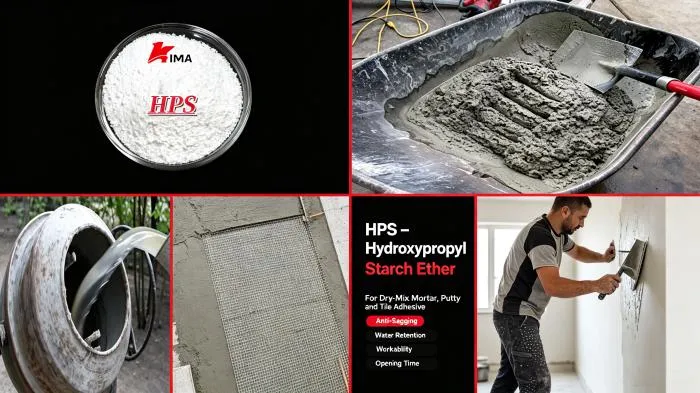
HPS is a modified starch-based, water-soluble polymer used in cement- and gypsum-based formulations. Its principal value in dry mix mortar is rheology control, anti-sag performance, improved workability, cohesion, and application stability. It is particularly useful in tile adhesives, wall putty, plaster, render, grout, EIFS/ETICS, waterproofing mortar, stucco, and related systems.
Importantly, HPS should not simply be regarded as a replacement for HPMC. Research on starch ethers and cellulose ethers shows that the two materials can affect mortar in different ways, making their combination useful when a formulation requires both water management and rheological control.
What Is Hydroxypropyl Starch Ether?
Hydroxypropyl Starch Ether is a chemically modified starch derivative produced by introducing hydroxypropyl groups into starch molecules through an etherification process.
The starting starch can come from plant-based sources such as corn, potato, or other starch materials. Modification changes the behavior of the original starch, giving HPS improved water compatibility and useful rheological properties.
Unlike ordinary starch, appropriately modified HPS can function effectively in water-based construction formulations. It can increase structural stability while allowing mortar to remain workable under shear.
A simplified description is:
Natural starch → chemical modification → hydroxypropyl starch ether → functional construction additive
HPS is generally supplied as a fine white or off-white powder.
Why Is HPS Used in Dry Mix Mortar?
Modern dry mix mortar is a complex formulation. Cementitious binders, aggregates, fillers, polymers, cellulose ethers, starch ethers, fibers, defoamers, and other additives must work together.
A mortar needs to satisfy apparently conflicting requirements:
· It must be easy to mix.
· It must spread smoothly.
· It must remain cohesive.
· It must resist sagging.
· It must maintain sufficient water.
· It should not separate.
· It should provide adequate adhesion.
· It should maintain consistent application behavior.
HPS is particularly valuable because it can modify the rheological behavior of the mortar.
One technical explanation describes HPS as a material that can decrease consistency under shear and recover consistency when shear is removed. This behavior helps reconcile flow during application with structural stability after application.
Main Functions of HPS in Dry Mix Mortar
HPS Function | Effect on Mortar |
Rheology modification | Controls flow and deformation |
Anti-sagging | Helps mortar remain on vertical surfaces |
Thickening | Improves body and consistency |
Cohesion improvement | Reduces separation |
Workability improvement | Supports smoother application |
Anti-slip effect | Helps reduce tile movement |
Structural build-up | Helps maintain layer thickness |
Troweling improvement | Can produce smoother application |
Compatibility | Works with many mortar components |
Formulation optimization | Can complement cellulose ether |
HPS is therefore best understood as a multifunctional rheology and application-performance modifier rather than simply a conventional thickener.
HPS and Rheology Control
Rheology describes how a material flows and deforms when subjected to force.
For dry mix mortar, rheology is extremely important because workers need a material that can be easily spread under pressure but remains stable after application.
For example, when a trowel is pressed against tile adhesive, the mortar experiences shear. The material needs to become sufficiently workable so that it spreads across the substrate.
After the trowel is removed, however, the mortar needs to regain sufficient structure to remain where it has been placed.
HPS can contribute to this balance.
This is particularly valuable in:
· Tile adhesive
· Wall plaster
· Gypsum plaster
· Wall putty
· EIFS
· Thick-layer mortar
HPS and Anti-Sag Performance
Sagging is a common problem in vertical construction applications.
If mortar does not have sufficient structural stability, gravity can cause it to move downward after application.
Potential consequences include:
· Uneven thickness
· Tile slipping
· Reduced productivity
· Poor surface quality
· Increased rework
HPS can increase the internal structure and rheological stability of mortar, helping it resist downward movement. Recent technical guidance specifically identifies anti-sagging and structural stability as major functions of HPS in dry mix mortar.
This makes HPS particularly attractive for vertical tile adhesive and plaster systems.
HPS in Tile Adhesive
Tile adhesive is one of the most important applications for HPS.
A modern tile adhesive must balance:
· Open time
· Water retention
· Workability
· Adhesion
· Anti-slip performance
· Cohesion
· Trowelability
HPS can contribute particularly strongly to the rheology and anti-sag side of this equation.
When installing tiles on vertical surfaces, the adhesive needs to support the tile without excessive downward movement.
HPS can help increase structural stability and reduce tile slip while maintaining workable application characteristics.
HPS and Workability
Good workability is essential for construction workers.
Mortar that is too dry can be difficult to spread. Mortar that is excessively sticky can adhere to tools and become difficult to finish.
An appropriate HPS grade can help create a smoother and more cohesive mortar texture.
Potential benefits include:
· Easier spreading
· Improved troweling
· Better consistency
· More uniform application
· Reduced segregation
· Improved finishing
Some commercial HPS products are specifically marketed for improving the "creamy" or smooth feel of mortar and reducing adhesion to tools.
HPS and Water Retention
HPS can contribute to water management, but this function should be carefully distinguished from the dominant water-retention role typically associated with cellulose ethers such as HPMC.
A published experimental study found that cellulose ether had a greater impact on water retention in ordinary dry-mix mortar, while starch ether produced different effects on hydration and setting behavior.
Therefore, a useful formulation principle is:
HPMC → primarily water retention and viscosity management
HPS → particularly rheology, anti-sag, and structural modification
The actual behavior depends on grade, dosage, formulation, and test conditions.
HPS and HPMC: Why Use Them Together?
HPS and HPMC can provide complementary functions.
Property | HPMC | HPS |
Water retention | Strong | Secondary/supporting |
Thickening | Strong | Strong |
Rheology control | Strong | Strong |
Anti-sag | Good | Strong contribution |
Open-time support | Strong | Supporting |
Workability | Good | Good |
Structural build-up | Good | Strong |
Cement-system compatibility | High for suitable grades | High for suitable grades |
The combination can allow formulators to obtain a better balance than either additive alone.
Research confirms that cellulose ether and starch ether have different effects on fresh mortar and hydration behavior, which supports the need to optimize their ratio rather than treating them as interchangeable materials.
HPS and RDP
Redispersible Polymer Powder (RDP) is another important additive in many dry mix mortar formulations.
RDP primarily contributes to:
· Adhesion
· Flexibility
· Cohesion
· Film formation
· Crack resistance
HPS focuses more strongly on:
· Rheology
· Anti-sag
· Workability
· Structural stability
Therefore, a typical high-performance tile adhesive may use:
Cement + sand/fillers + HPMC + HPS + RDP + other additives
Each component performs a different function.
HPS in Wall Putty
Wall putty needs to provide:
· Smooth application
· Good surface finish
· Appropriate consistency
· Low sag
· Easy sanding or finishing
· Stable application
HPS can improve rheological control and help the putty maintain a stable layer on vertical surfaces.
Too much HPS, however, can make the formulation excessively thick or sticky.
Consequently, dosage must be optimized rather than maximized.
HPS in Gypsum Plaster
Gypsum-based plaster is another important application.
Machine-sprayed gypsum creates a special rheological challenge.
The material needs to be fluid enough to move through the equipment but sufficiently structured after application to remain on the wall.
HPS can help address this balance by modifying rheology and improving anti-sag behavior. This is one reason starch ether is used in plastering and gypsum systems.
HPS in EIFS and ETICS
External insulation systems require mortar with good:
· Adhesion
· Cohesion
· Workability
· Anti-sag performance
· Layer stability
HPS can be used in EIFS/ETICS formulations to improve rheological behavior and application stability.
This can be particularly useful when the adhesive or basecoat is applied vertically.
HPS in Grout and Joint Fillers
Tile grout and joint fillers require good:
· Cohesion
· Smooth application
· Stability
· Water management
· Surface finish
HPS can contribute to rheology and consistency, helping the formulation remain uniform during application.
However, grout formulations vary considerably, so the appropriate grade should be determined through testing.
Typical HPS Dosage
There is no single universal HPS dosage for every mortar.
The appropriate level depends on:
· HPS grade
· Viscosity
· Cement content
· Aggregate grading
· HPMC dosage
· RDP dosage
· Water content
· Application thickness
· Desired rheology
Some commercial construction formulations recommend very low HPS dosages, while specific products and formulations may require different levels. One supplier, for example, describes a typical HPS usage range of approximately 0.01–0.05% of the dry mix for certain construction systems. This should be treated as a formulation-specific starting point rather than a universal specification.
The best approach is laboratory optimization.
HPS Dosage Optimization
A practical formulation study can compare several levels:
Trial | HPS Level | Evaluation |
A | Low | Flow and basic rheology |
B | Low-medium | Workability |
C | Medium | Anti-sag and cohesion |
D | Medium-high | Structural stability |
E | High | Check for over-thickening |
The objective is not to maximize viscosity.
The objective is to find the dosage that produces the best balance between:
Workability + anti-sag + cohesion + application efficiency
Factors Affecting HPS Performance
HPS performance depends on more than dosage.
Important variables include:
HPS viscosity
Higher-viscosity HPS can provide stronger rheological effects.
Substitution characteristics
Chemical modification influences water interaction and performance.
Particle size
Particle size affects dispersion and hydration.
Formulation pH
Different systems may influence polymer behavior differently.
Temperature
Temperature can influence hydration and rheological response.
HPMC concentration
HPMC and HPS can interact synergistically, so changing HPMC dosage may change the optimum HPS level.
RDP
Polymer powder can significantly change mortar rheology and adhesion.
HPS and Cement Hydration
HPS can affect cement hydration and setting behavior.
Scientific research comparing cellulose and starch ethers has demonstrated that starch ether can influence hydration and delay setting and hardening under certain test conditions. The magnitude of the effect depends on polymer type and dosage.
This is why manufacturers should evaluate:
· Initial setting
· Final setting
· Workability retention
· Early strength
· Later strength
when introducing HPS into a cement-based formulation.
HPS and Mortar Strength
HPS is primarily a fresh-state performance modifier rather than a direct strength enhancer.
Its indirect contribution to final performance can come from improved:
· Application
· Cohesion
· Water management
· Coverage
· Uniformity
However, excessive polymer addition can change the water balance and hydration behavior.
Therefore, compressive strength, tensile adhesion strength, and other relevant properties should be measured during formulation development.
Advantages of HPS in Dry Mix Mortar
The main advantages can be summarized as follows:
1. Improved rheological control
2. Better anti-sag performance
3. Improved workability
4. Enhanced mortar cohesion
5. Better troweling behavior
6. Improved tile slip resistance
7. Good compatibility with HPMC
8. Useful in cement and gypsum systems
9. Potential formulation cost optimization
10. Support for more efficient construction
Potential Problems from Excessive HPS
Like all formulation additives, HPS must be used at an optimized level.
Excessive dosage can potentially cause:
· Excessive viscosity
· Reduced flow
· Sticky mortar
· Difficult troweling
· Poor machine pumping
· Changes in setting behavior
· Increased material cost
Therefore:
More HPS ≠ better mortar.
The correct dosage is the minimum amount that achieves the required performance without creating undesirable side effects.
HPS vs HPMC
Characteristic | HPS | HPMC |
Raw material | Modified starch | Modified cellulose |
Main construction role | Rheology/anti-sag | Water retention/rheology |
Anti-slip | Strong contribution | Good |
Water retention | Supporting | Strong |
Workability | Strong | Strong |
Open time | Supporting | Strong |
Structural build-up | Strong | Good |
Typical role | Complementary additive | Primary cellulose ether |
This comparison should not be interpreted as saying that HPS is "better" or HPMC is "better." They solve different formulation problems.
HPS Selection Guide
When selecting HPS, manufacturers should consider:
Selection Factor | Key Question |
Application | Tile adhesive, plaster, putty or EIFS? |
Viscosity | How much rheological modification is required? |
Solubility | How quickly should it hydrate? |
Particle size | Is rapid dispersion required? |
pH stability | Will it operate in alkaline mortar? |
Compatibility | Does it work with HPMC/RDP? |
Dosage | What level provides the target performance? |
Consistency | Can the supplier maintain batch uniformity? |
Quality Control of HPS
A professional HPS quality-control program may include:
· Appearance
· Moisture
· Viscosity
· pH
· Ash
· Solubility
· Particle size
· Purity
· Batch consistency
For construction-grade HPS, the most important parameters depend on the intended application.
A supplier's technical data sheet should clearly specify the testing conditions used for viscosity.
How to Develop an HPS-Modified Dry Mortar
A practical development process can follow these steps:
Step 1: Define the application
Identify the mortar type.
Step 2: Establish the performance target
For example:
· Anti-sag
· Smooth troweling
· Open time
· Flow
Step 3: Select HPMC
Determine the primary water-retention and rheology requirements.
Step 4: Screen HPS
Test several HPS grades or dosages.
Step 5: Optimize RDP and other additives
Avoid evaluating HPS independently from the complete formulation.
Step 6: Conduct application tests
Test the mortar under realistic conditions.
Step 7: Verify mechanical properties
Measure adhesion, strength, and durability as required.
FAQ: HPS in Dry Mix Mortar
What is HPS?
HPS stands for Hydroxypropyl Starch Ether, a chemically modified starch derivative used as a functional additive in construction materials.
What is the main function of HPS in mortar?
Its major functions include rheology modification, anti-sagging, structural stabilization, and workability improvement.
Is HPS the same as HPMC?
No. HPS is a modified starch ether, while HPMC is a modified cellulose ether. They have different performance profiles.
Can HPS replace HPMC?
Usually, HPS should not be considered a direct one-to-one replacement for HPMC because HPMC generally provides stronger water-retention functionality.
Why combine HPS with HPMC?
The two additives can provide complementary effects: HPMC contributes strongly to water retention while HPS can strengthen rheological and anti-sag performance.
Is HPS useful in tile adhesive?
Yes. HPS can improve anti-sagging, cohesion, workability, and tile-slip resistance.
Does HPS improve water retention?
It can contribute to water management, but cellulose ether generally has a stronger effect on water retention in ordinary dry-mix mortar according to comparative research.
Can HPS be used in gypsum mortar?
Yes. It can be used in gypsum plaster and other gypsum-based systems to modify rheology and improve application stability.
Can HPS improve mortar workability?
Yes. Appropriate grades and dosages can improve spreadability, troweling, consistency, and application feel.
What happens if too much HPS is used?
The mortar may become excessively viscous or sticky, reducing flow and making application more difficult.
What is the recommended HPS dosage?
There is no universal dosage. A commercial technical source gives approximately 0.01–0.05% as a typical starting range for certain dry-mix systems, but actual dosage must be established experimentally for each formulation.
Does HPS affect cement setting?
It can. Research indicates that starch ether can affect hydration and setting behavior, with the magnitude depending on the type and dosage.
Is HPS suitable for EIFS?
Yes. HPS can be used in EIFS/ETICS adhesive and basecoat formulations for rheology and anti-sag control.
Does HPS improve adhesion?
It can indirectly support adhesion by improving cohesion, wetting, application stability, and water management, but final bond strength depends on the complete formulation.
Hydroxypropyl Starch Ether has evolved into an important functional additive for modern dry mix mortar. Its greatest value lies not simply in thickening mortar, but in controlling rheology and balancing workability with structural stability.
For tile adhesives, HPS can help reduce sagging and tile slip. In wall putty and plaster, it can improve consistency and application behavior. In gypsum-based materials, it can help reconcile flowability with vertical stability. In EIFS and other specialty mortars, it can contribute to cohesion and controlled rheology.
Perhaps most importantly, HPS should be considered complementary to HPMC rather than simply an alternative. Comparative scientific research shows that cellulose ether and starch ether affect mortar properties differently, particularly with respect to water retention, consistency, hydration, and setting.
A high-performance dry mix mortar therefore depends on balancing the entire formulation:
HPMC + HPS + RDP + cement + aggregate + fillers + other additives + water
The best HPS grade and dosage should be determined through controlled laboratory testing and realistic application trials. By optimizing HPS rather than simply increasing its dosage, manufacturers can achieve better anti-sag performance, workability, cohesion, rheological stability, and construction efficiency while maintaining a balanced formulation cost.


 English
 日本語
日本語 français
 Deutsch
 Español
 العربية
 Türkçe
 italiano
 русский
 português
 Nederland