Polyanionic Cellulose (PAC) is a water-soluble cellulose derivative widely used as a functional polymer in oil and gas drilling fluids, especially water-based mud systems. It is valued primarily for its ability to control fluid loss, modify rheology, improve filter-cake quality, and help stabilize reactive shale and drill cuttings.
PAC is produced by chemically modifying natural cellulose to introduce anionic functional groups. Its molecular structure allows it to interact strongly with water and suspended solids, making it an important drilling-fluid additive. API Specification 13A specifically recognizes low-viscosity PAC (PAC-LV) and high-viscosity PAC (PAC-HV) among materials used in oil- and gas-well drilling fluids.
What Is PAC?
Polyanionic Cellulose, commonly abbreviated as PAC, is an anionic cellulose ether derived from purified natural cellulose. During manufacturing, cellulose is chemically etherified to introduce negatively charged groups along its polymer chains.
These functional groups improve water solubility and provide PAC with useful interactions with clay particles, drill cuttings, and formation surfaces.
PAC is generally supplied as a white or off-white free-flowing powder. Depending on molecular weight, viscosity and formulation requirements, it is available in several grades, particularly low-viscosity and high-viscosity grades. Commercial PAC products are designed for different water-based drilling-fluid systems, including freshwater, seawater, KCl and saltwater systems.
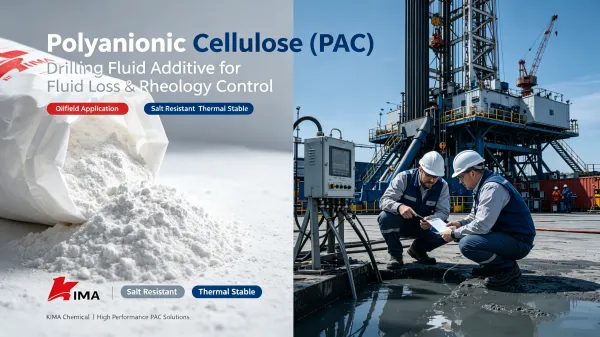
How Does PAC Work in Drilling Fluids?
The most important function of PAC is fluid-loss control.
When PAC is dispersed in a water-based drilling mud, its polymer chains hydrate and interact with suspended particles. During filtration, PAC helps create a thin, tough and relatively low-permeability filter cake on the wellbore wall. This reduces the amount of liquid filtrate entering permeable formations.
PAC can also encapsulate or interact with exposed shale and drill cuttings. This can reduce cutting dispersion and help maintain better solids integrity.
In addition, PAC modifies the rheology of the drilling fluid. Depending on the grade, it can increase viscosity and improve suspension and carrying capacity while maintaining useful flow behavior.
Main Functions of PAC
Function | How PAC Helps | Main Benefit |
Fluid-loss control | Builds a low-permeability filter cake | Reduces filtrate invasion |
Rheology modification | Increases polymeric viscosity | Improves suspension |
Shale stabilization | Encapsulates reactive surfaces | Helps reduce shale dispersion |
Cuttings protection | Helps inhibit cutting disintegration | Better solids control |
Filter-cake improvement | Produces a thin and resilient cake | Reduces differential sticking risk |
Salt-water performance | Maintains functionality in various brines | Wider application range |
PAC-LV vs. PAC-HV
One of the most important distinctions when selecting PAC is viscosity grade.
PAC-LV is a low-viscosity grade designed mainly for filtration control with relatively limited viscosity increase. It is useful when fluid-loss reduction is required but excessive rheological buildup must be avoided.
PAC-HV has higher molecular weight and provides stronger viscosity contribution in addition to filtration control. It can be useful where suspension, carrying capacity and rheology modification are important.
API Spec 13A identifies both PAC-LV and PAC-HV as standardized drilling-fluid materials.
Characteristic | PAC-LV | PAC-HV |
Viscosity contribution | Low | High |
Main purpose | Fluid-loss control | Fluid loss + rheology |
Molecular weight | Generally lower | Generally higher |
Effect on mud viscosity | Limited | Greater |
Typical application | High-density or low-rheology systems | Systems requiring additional suspension |
Filtration control | Excellent | Excellent |
Selection priority | Minimize viscosity increase | Build rheology and control filtration |
Why Is PAC Important in Oil Drilling?
Drilling fluid must perform several functions simultaneously. It transports drilled cuttings, controls formation pressure, cools and lubricates the drill bit, stabilizes the wellbore and limits unwanted fluid invasion.
Poor fluid-loss control can allow excessive filtrate to enter permeable formations. This can contribute to formation damage, instability and other drilling problems.
PAC helps address these challenges by improving filtration characteristics and forming a protective filter cake. Commercial PAC products are used in freshwater, seawater, KCl and saltwater drilling fluids.
A high-quality PAC can therefore contribute to:
· Lower fluid loss
· Improved wellbore stability
· Better cuttings integrity
· Improved suspension
· Reduced formation-fluid invasion
· Better drilling-fluid consistency
· Improved filtration performance
PAC in Water-Based Drilling Mud
Water-based muds are one of the most important application areas for PAC.
In a typical water-based mud, PAC works alongside other additives such as bentonite, weighting agents, shale inhibitors, lubricants and other rheology or filtration-control materials.
The exact PAC concentration depends on mud composition, salinity, temperature, density, formation characteristics and the desired filtration properties. Commercial products may have different recommended treatment levels, so laboratory testing and supplier specifications should be followed rather than using one universal dosage. For example, one commercial ultralow-viscosity PAC lists a normal fluid-loss treatment range of 0.25–1 lb/bbl, while another technical-grade product recommends a broader range depending on water type and salt concentration.
PAC and Fluid-Loss Control
Fluid-loss control is arguably PAC's most important application.
During filtration, the polymer contributes to the formation of a compact filter cake. A good filter cake should be:
· Thin
· Tough
· Low permeability
· Resilient
· Easy to remove when appropriate
A well-designed PAC system can reduce filtrate invasion while maintaining suitable drilling-fluid rheology. This balance is particularly important because simply increasing viscosity is not always the best way to control filtration.
PAC and Shale Inhibition
Reactive shale can absorb water, swell and disperse into the drilling fluid. PAC can attach to exposed shale and drill-cutting surfaces, helping form a protective polymer layer.
This action can reduce cutting disintegration and improve solids-control performance. Commercial drilling-fluid PAC products are specifically marketed for encapsulating exposed shale and drill cuttings and restricting their interaction with water.
However, PAC should not be considered a complete shale-inhibition system by itself. In difficult formations, it is normally used together with other inhibitors and carefully designed mud chemistry.
PAC Manufacturing and Quality
PAC manufacturing starts with purified cellulose. Through controlled etherification, anionic groups are introduced into the cellulose structure. After purification, drying and milling, the material is processed into a powder suitable for rapid dispersion and hydration.
Important quality parameters can include:
Quality Parameter | Importance |
Viscosity | Determines rheological contribution |
Degree of substitution | Influences ionic character and solubility |
Moisture | Affects storage and handling |
Purity | Influences consistency and performance |
Particle size | Affects dispersion and hydration |
Fluid-loss performance | Key indicator of drilling performance |
pH | Important for formulation compatibility |
Salt tolerance | Important for brine and seawater systems |
For example, one commercial PAC-HV specification lists pH of 6.5–8.0 for a 1% solution, moisture ≤10%, and fluid loss ≤18 mL under its specified test conditions. Such specifications are product-specific and should not be treated as universal PAC limits.
How to Choose the Right PAC Grade
Selecting PAC should begin with the drilling-fluid objective rather than simply choosing the highest-viscosity product.
For strong filtration control with minimal rheological impact, PAC-LV is often the logical starting point. Where additional viscosity and suspension capacity are required, PAC-HV may be more appropriate.
Other factors include:
1. Water type – freshwater, seawater, KCl or high-salinity brine.
2. Mud density – high-density systems can require careful viscosity management.
3. Temperature – high-temperature wells require suitable thermal performance.
4. Formation characteristics – reactive shale and permeable formations may require different strategies.
5. Required filtration performance – laboratory filtration testing should guide dosage.
6. Mixing equipment – dispersibility is important for consistent performance.
Advantages of Polyanionic Cellulose
PAC has become an important drilling-fluid polymer because it combines several useful functions.
1. Excellent Fluid-Loss Control
PAC can significantly reduce filtration and help create a protective filter cake.
2. Flexible Viscosity Control
Different viscosity grades allow formulators to balance filtration performance against rheological requirements.
3. Broad Water Compatibility
Commercial PAC products are available for freshwater, seawater, KCl and saltwater systems.
4. Improved Cuttings Integrity
PAC can help encapsulate drill cuttings and reduce their dispersion.
5. Useful Thermal Performance
Some commercial PAC systems are designed for demanding temperature conditions. For example, one commercial PAC polymer reports thermal stability to at least 300°F in most water-based drilling fluids.
PAC vs. CMC
PAC and carboxymethyl cellulose (CMC) are both cellulose-derived polymers used in drilling fluids, particularly for filtration control. However, drilling-grade PAC is specifically standardized in API Spec 13A in low- and high-viscosity categories.
Feature | PAC | CMC |
Chemical family | Anionic cellulose ether | Anionic cellulose ether |
Water solubility | High | High |
Fluid-loss control | Excellent | Good–excellent depending on grade |
Rheology control | Grade-dependent | Grade-dependent |
Drilling applications | Very common | Very common |
API drilling-fluid categories | PAC-LV/PAC-HV | CMC-LVT/CMC-HVT |
The best choice depends on mud formulation, performance targets and applicable specifications.
Frequently Asked Questions
What is PAC used for?
PAC is primarily used in water-based drilling fluids for fluid-loss control and rheology modification. It can also support shale and cutting stabilization.
What does PAC stand for?
PAC stands for Polyanionic Cellulose.
Is PAC water soluble?
Yes. Drilling-grade PAC is designed to hydrate and dissolve/disperse in water-based systems.
What is PAC-LV?
PAC-LV means low-viscosity polyanionic cellulose. It is mainly selected when strong filtration control is required without creating excessive viscosity.
What is PAC-HV?
PAC-HV means high-viscosity polyanionic cellulose. It provides fluid-loss control while contributing more significantly to mud viscosity and suspension.
Is PAC suitable for seawater drilling mud?
Yes. Commercial PAC products are available for seawater and saltwater drilling systems.
Does PAC control shale?
PAC can help reduce shale and cutting dispersion by encapsulating exposed surfaces, but complete shale inhibition generally requires a broader drilling-fluid formulation.
Is PAC included in API specifications?
Yes. API Specification 13A covers both PAC-LV and PAC-HV among specified drilling-fluid materials.
Polyanionic Cellulose (PAC) is a versatile cellulose-based polymer that plays a central role in modern water-based drilling-fluid formulations. Its combination of fluid-loss control, rheology modification, filter-cake formation and cutting encapsulation makes it valuable across a wide range of drilling conditions.
PAC-LV is generally preferred when filtration control is needed with minimal viscosity increase, while PAC-HV is useful when filtration control must be combined with stronger rheological performance. Proper grade selection should consider salinity, temperature, mud density, formation characteristics and laboratory test results.
As drilling operations move toward more challenging wells—including high-temperature, high-pressure, deepwater and extended-reach applications—consistent PAC quality and formulation compatibility remain important considerations for drilling-fluid performance. API's current referenced drilling-fluid specification includes both PAC-LV and PAC-HV categories.


 English
 日本語
日本語 français
 Deutsch
 Español
 العربية
 Türkçe
 italiano
 русский
 português
 Nederland