Specification of Diacetone Acrylamide (DAAM)
Diacetone Acrylamide (DAAM) is a functional acrylic monomer used primarily in waterborne coatings, adhesives, inks, sealants, and crosslinkable polymer systems. Typical commercial specifications may vary by manufacturer and grade.
Typical DAAM Specification
Parameter | Typical Specification |
Product Name | Diacetone Acrylamide |
Abbreviation | DAAM |
CAS No. | 2873-97-4 |
Chemical Formula | C₉H₁₅NO₂ |
Molecular Weight | 169.22 g/mol |
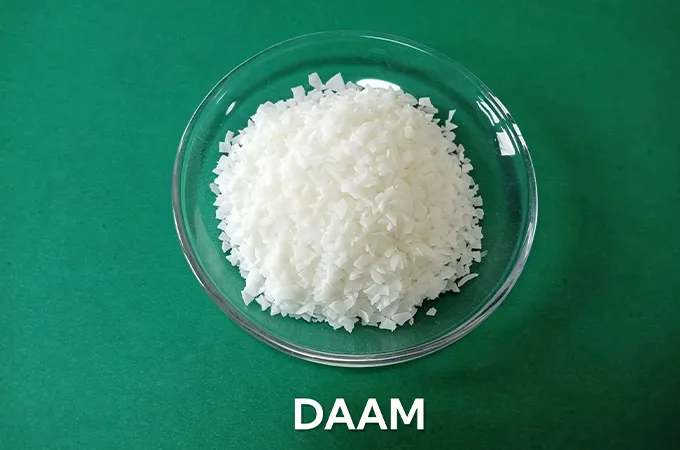
Appearance | White crystalline powder |
Purity | ≥98.0% |
Melting Point | Approximately 110–114°C |
Moisture | Typically ≤0.5% |
Solubility | Soluble in water and selected organic solvents |
Active Content | Typically ≥98% |
Main Functional Group | Ketone |
Polymerizable Group | Acrylamide |
Application | Waterborne polymers and coatings |
Key Quality Parameters
1. Purity: High purity helps ensure consistent polymerization and predictable final-product performance.
2. Moisture: Low moisture is generally preferred for stable storage, handling and formulation.
3. Appearance: The product should normally be a clean, uniform white crystalline solid without obvious contamination.
4. Melting Point: Melting-point testing can be used as an important quality-control and identification parameter.
5. Polymerization Stability: DAAM should maintain appropriate stability during storage and handling while remaining suitable for incorporation into polymerization systems.
DAAM Functional Characteristics
DAAM contains a polymerizable acrylamide group and a reactive ketone group. After incorporation into an acrylic polymer, the ketone functionality can react with Adipic Acid Dihydrazide (ADH) to produce crosslinking.
This makes DAAM particularly useful for developing polymers with improved:
· Water resistance
· Chemical resistance
· Adhesion
· Hardness
· Mechanical strength
· Abrasion resistance
· Film durability
Application of Diacetone Acrylamide (DAAM)?
Diacetone Acrylamide (DAAM) is a functional acrylic monomer mainly used to introduce ketone-functional groups into polymers. Its most important application is in waterborne polymer systems, where it can react with Adipic Acid Dihydrazide (ADH) to create crosslinked polymer networks.
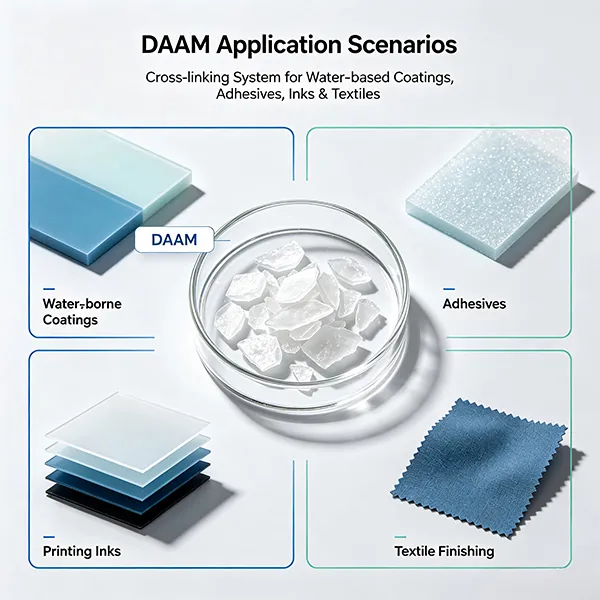
Main Applications
Application | Role of DAAM | Potential Benefits |
Water-Based Coatings | Functional monomer | Improved water and chemical resistance |
Acrylic Emulsions | Introduces ketone groups | Enables post-crosslinking |
Adhesives | Reactive polymer modification | Improved adhesion and durability |
Printing Inks | Polymer functionalization | Better film resistance |
Textile Coatings | Crosslinkable monomer | Improved finish durability |
Sealants | Polymer modification | Enhanced mechanical properties |
Protective Coatings | Crosslinking functionality | Improved hardness and durability |
Industrial Coatings | Reactive component | Better chemical and abrasion resistance |
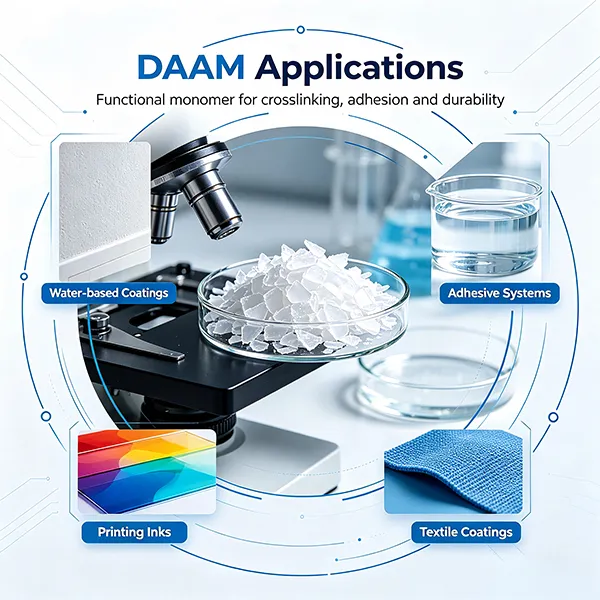
DAAM in Water-Based Coatings
DAAM is particularly useful in waterborne acrylic coatings. During polymerization, DAAM becomes incorporated into the polymer chain and provides reactive ketone groups. These groups can subsequently react with ADH, helping form a crosslinked film.
This technology can improve:
· Water resistance
· Chemical resistance
· Film hardness
· Adhesion
· Abrasion resistance
· Blocking resistance
· Overall coating durability
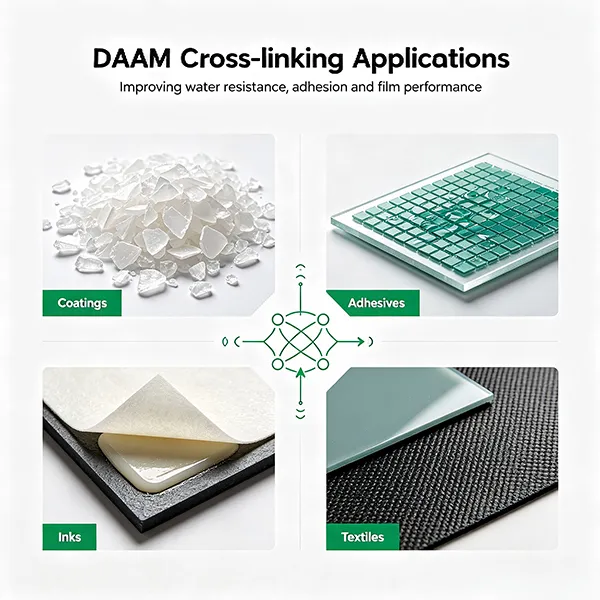
DAAM + ADH Crosslinking
One of the most important applications is the DAAM/ADH crosslinking system:
DAAM → ketone-functional polymer → ADH reaction → crosslinked polymer film
DAAM therefore acts primarily as the functional monomer, while ADH acts as the crosslinking agent.
Why Manufacturers Use DAAM
DAAM is attractive because it allows manufacturers to develop crosslinkable waterborne polymers without relying exclusively on conventional solvent-based technologies. It can be used in acrylic emulsions and other polymer systems where improved final-film performance is required.
For manufacturers, DAAM selection should consider purity, moisture, particle form, polymerization compatibility, dosage, storage stability, and compatibility with the selected polymer system.
In summary, DAAM is mainly used to add reactive ketone functionality to polymers, enabling crosslinking and improving the performance of water-based coatings, adhesives, inks, sealants, and textile formulations.
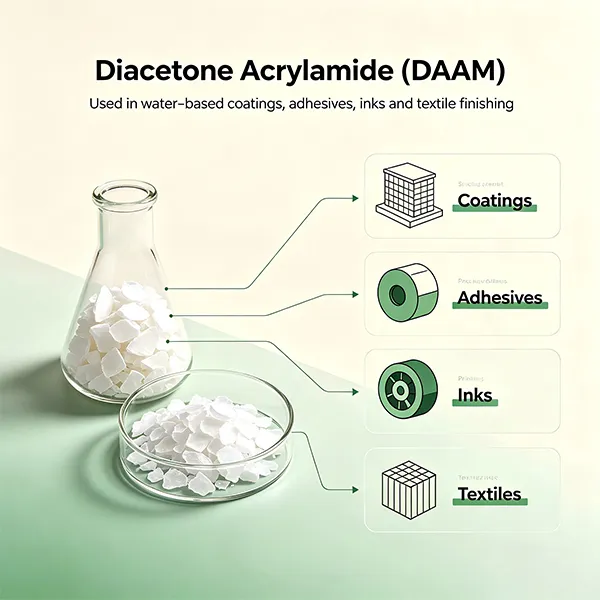
What Is Diacetone Acrylamide (DAAM) Used For?
Diacetone Acrylamide (DAAM) is a functional acrylic monomer mainly used in water-based coatings, adhesives, inks, sealants, and textile formulations. It introduces reactive ketone groups into polymers, allowing subsequent crosslinking with agents such as Adipic Acid Dihydrazide (ADH). This chemistry can improve water resistance, chemical resistance, hardness, adhesion, flexibility, and film durability. DAAM is especially valuable for manufacturers developing high-performance, crosslinkable waterborne acrylic polymers with improved durability and low-VOC formulation potential.
How Do You Use Diacetone Acrylamide (DAAM)?
Diacetone Acrylamide (DAAM) is incorporated during polymerization to introduce ketone functionality into polymers, then crosslinked with ADH to improve coatings, adhesives, inks, and sealants.


 English
 日本語
日本語 français
 Deutsch
 Español
 العربية
 Türkçe
 italiano
 русский
 português
 Nederland

 MSDS Diacetone acrylamide (DAAM)