Introduction
Hydroxypropyl Methyl Cellulose (HPMC), also known as hypromellose or food additive E464, is a versatile cellulose ether derived from cellulose. Because of its water-binding, thickening, stabilizing, emulsifying, film-forming, and thermal-gelling properties, HPMC has become an important functional ingredient in modern food formulation.
The U.S. Food and Drug Administration lists hydroxypropyl methylcellulose among substances added to food and identifies functions including stabilizer or thickener, emulsifier, texturizer, humectant, processing aid, and surface-finishing agent. U.S. regulations under 21 CFR §172.874 permit its use in food for functions including emulsification, film formation, protective colloid action, stabilization, suspension, and thickening when used according to good manufacturing practice.
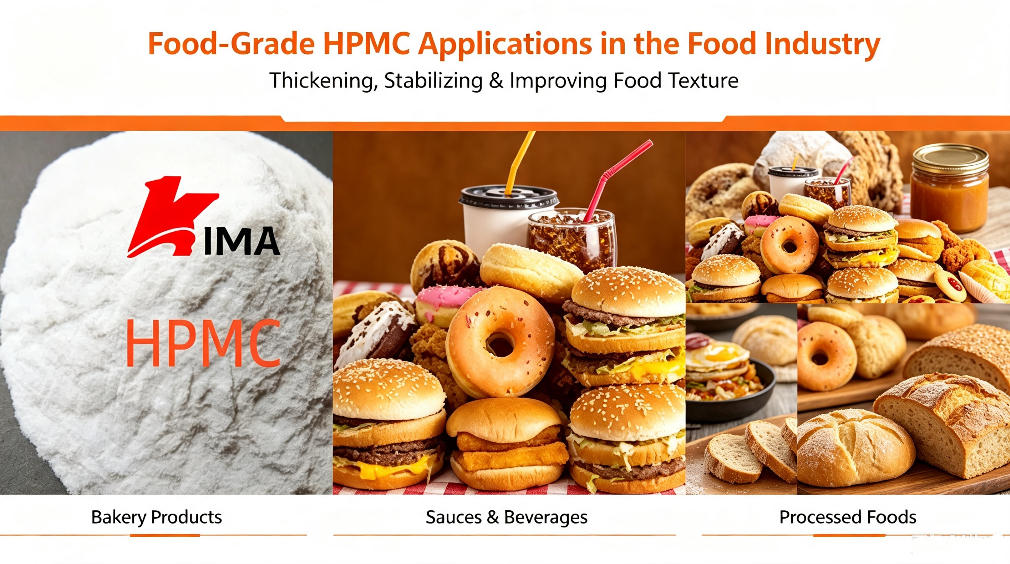
Today, HPMC is used in bakery products, plant-based foods, sauces, beverages, frozen foods, dairy alternatives, nutritional products, and convenience foods. Its multifunctional performance allows manufacturers to improve product quality while responding to consumer demand for convenient, stable, reduced-fat, gluten-free, and plant-based foods.
What Is HPMC?
For formulators looking to understand what is hydroxypropyl methylcellulose made from, HPMC is a nonionic, water-soluble cellulose derivative produced by modifying cellulose with methyl and hydroxypropyl groups. Its performance can be adjusted by controlling substitution characteristics, molecular weight, particle size, and viscosity grade.
When properly dispersed and hydrated, HPMC can increase the viscosity of food systems. One particularly useful characteristic is its thermal gelation behavior: depending on grade and formulation conditions, HPMC can form a gel during heating and contribute to structural integrity during cooking or baking.
These properties make HPMC different from many conventional hydrocolloids. Rather than serving only as a thickener, it can perform several functions within the same formulation.
Major Applications of HPMC in Food
Food Application | Main Function of HPMC | Typical Benefits |
Bread and bakery products | Water retention, structure improvement | Better softness and volume |
Gluten-free foods | Binder and structural aid | Improved elasticity and texture |
Plant-based meat | Binder, emulsifier, thermal gel | Better shape and cooking performance |
Sauces and dressings | Thickener and stabilizer | Improved viscosity and uniformity |
Beverages | Suspension stabilizer | Reduced sedimentation |
Frozen desserts | Texture and stabilization | Improved body and mouthfeel |
Meat products | Binder and water-management aid | Better structure and moisture retention |
Low-fat foods | Texture modifier | Creamier mouthfeel |
Convenience foods | Thickener and stabilizer | Improved consistency |
1. Bakery Products
One of the most important applications of HPMC is bakery formulation. It can help retain moisture, improve dough structure, and contribute to the volume and texture of finished products.
This is especially valuable in gluten-free bread. Gluten normally provides elasticity and gas-retention properties in wheat-based dough. When gluten is removed, manufacturers need alternative ingredients to help create a stable structure. HPMC can contribute to dough viscosity and gas-cell stabilization, helping gluten-free bread achieve improved volume, softness, and sliceability.
During baking, HPMC's thermal behavior can contribute to structural setting. This can help products maintain their shape as the internal structure develops.
2. Gluten-Free Food
Gluten-free formulation is a particularly important area for HPMC. Without gluten, dough can become fragile, sticky, or difficult to process.
In hydroxypropyl methylcellulose gluten free formulations, HPMC can function as a binder and structural modifier, improving the cohesion and handling properties of gluten-free dough. It may also help reduce crumbling and improve moisture retention.
For manufacturers, the correct HPMC grade and dosage are critical. Excessive use can produce an overly dense or gummy texture, while insufficient use may not provide enough structural support.
3. Plant-Based Meat Products
The growth of plant-based foods has created new opportunities for functional hydrocolloids. HPMC is used in some plant-based meat formulations to help bind ingredients and improve texture.
During heating, HPMC can contribute to the formation of a firm structure. This can help plant-based patties, nuggets, meatballs, and similar products maintain their shape during cooking.
It can also contribute to moisture management and improve the overall bite and juiciness perception of formulated products.
4. Sauces, Dressings, and Condiments
HPMC can serve as a thickener and stabilizer in sauces, dressings, gravies, and other semi-liquid foods. Increasing viscosity helps improve body, cling, and consistency.
It can also help maintain a more uniform food system by reducing movement of dispersed components. The FDA identifies HPMC as suitable for functions including stabilizing, suspending, emulsifying, and thickening under applicable food-use conditions.
For products such as salad dressings and sauces, formulation engineers can select different viscosity grades depending on the desired pouring characteristics and final texture.
5. Beverages and Dairy Alternatives
HPMC can be used in beverages and dairy-alternative formulations where suspension stability and mouthfeel are important.
In systems containing dispersed particles, appropriate viscosity control can reduce sedimentation. HPMC may also contribute body and a smoother sensory profile.
Plant-based beverages can be particularly challenging because proteins, minerals, oils, and other ingredients may interact and separate during storage. HPMC can be incorporated as part of a broader stabilization system to help maintain product uniformity.
6. Frozen Foods and Desserts
Frozen foods undergo significant changes during freezing and thawing. Water migration and ice-crystal formation can negatively influence texture.
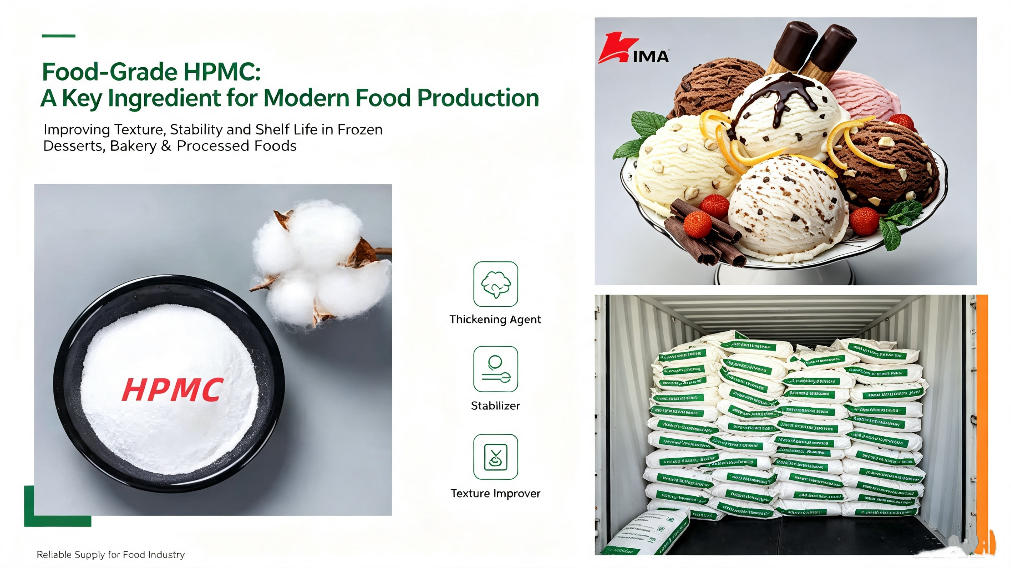
HPMC can contribute to viscosity, water management, and structural stability in selected frozen-food applications. In frozen desserts, cellulose-based hydrocolloids are used to improve body, texture, and stability.
The choice of HPMC should consider processing temperature, solids content, pH, salts, and other hydrocolloids in the formulation.
7. Meat and Processed Food Products
HPMC can contribute to binding and water-management functions in processed food formulations. It may help maintain structure and improve consistency when products are processed and heated.
In formulated meat alternatives, HPMC is particularly useful because thermal gelation can help create a firm structure after cooking. This makes it a useful tool for manufacturers seeking plant-based alternatives with improved shape retention and bite.
Key Advantages of HPMC in Food Formulation
Advantage | Description |
Thickening | Increases viscosity and improves body |
Stabilization | Helps maintain uniformity during storage |
Water management | Helps control moisture migration |
Thermal gelation | Provides structure during heating |
Emulsification support | Helps stabilize certain oil-water systems |
Suspension | Helps keep dispersed particles uniformly distributed |
Film formation | Can create protective surface films |
Texture improvement | Enhances body, softness, and mouthfeel |
Gluten-free functionality | Helps provide structure where gluten is absent |
Fat-reduction support | Can help replace some texture normally provided by fat |
How HPMC Improves Food Quality
The major advantage of HPMC is its multifunctionality. A manufacturer may use one suitable HPMC grade to address several formulation challenges simultaneously.
For example, in gluten-free bread, HPMC may contribute to dough handling, gas retention, moisture management, and final structure. In a sauce, the same broad category of ingredient may provide viscosity, suspension stability, and improved mouthfeel.
HPMC can therefore help reduce the need to combine numerous functional ingredients, although actual formulation requirements vary considerably from one food system to another.
Factors Affecting HPMC Performance
HPMC performance depends on several variables. The most important include viscosity grade, concentration, temperature, pH, ionic strength, processing conditions, and interactions with proteins, starches, fats, sugars, and other hydrocolloids.
Factor | Possible Effect |
HPMC viscosity | Controls thickening and flow behavior |
Dosage | Determines strength of functional effect |
Temperature | Influences hydration and thermal gelation |
pH | Can affect overall formulation stability |
Salts | May influence hydration and rheology |
Sugar | Can influence water availability |
Mixing conditions | Affect dispersion and hydration |
Other hydrocolloids | May produce synergistic or competitive effects |
Therefore, selecting HPMC should not be based solely on viscosity. Food manufacturers should evaluate the complete formulation and processing conditions.
Regulatory and Quality Considerations
Food-grade HPMC must meet applicable specifications and regulatory requirements in the target market. In the United States, 21 CFR §172.874 specifies conditions for food use, including compliance with the applicable definition and specifications and use according to good manufacturing practice.
Manufacturers should also verify supplier documentation, food-grade specifications, purity, microbiological quality, heavy-metal limits where applicable, viscosity, moisture, particle size, and batch-to-batch consistency.
Importantly, regulatory requirements differ between countries and applications. A food manufacturer should always confirm that the selected HPMC grade is authorized for the intended product and market.
Frequently Asked Questions
1. What is HPMC used for in food?
HPMC is used as a thickener, stabilizer, emulsifier, suspending agent, film former, texturizer, and water-management ingredient. FDA food-substance records identify several of these technical functions.
2. Is HPMC the same as hypromellose?
Yes. Hypromellose is another common name for hydroxypropyl methylcellulose.
3. What is the food additive number for HPMC?
HPMC is commonly identified as E464 in international food-ingredient terminology.
4. Can HPMC be used in gluten-free bread?
Yes. HPMC can help provide structure, moisture retention, dough cohesion, and improved texture in gluten-free bakery products.
5. Can HPMC replace fat?
HPMC can contribute body and creamy mouthfeel in reduced-fat formulations, but it does not simply replace all of the technological and sensory functions of fat. Formulation trials are necessary.
6. Does HPMC thicken food?
Yes. HPMC hydrates in water and can increase viscosity. The degree of thickening depends on its grade, concentration, temperature, and formulation environment.
7. Can HPMC stabilize beverages?
Yes. HPMC can contribute to suspension stability and viscosity control, helping reduce sedimentation of dispersed ingredients in appropriate beverage systems.
8. What HPMC viscosity should be used for food?
There is no single ideal viscosity grade. The correct grade depends on the desired texture, processing method, dosage, and food matrix. Laboratory testing is recommended before commercial production.
9. Is food-grade HPMC different from construction-grade HPMC?
Yes. Although the underlying polymer family may be similar, food applications require grades manufactured and controlled according to applicable food specifications. Food manufacturers should use an HPMC grade specifically intended and authorized for food use.
Hydroxypropyl Methyl Cellulose has become an important multifunctional ingredient in food formulation because it combines thickening, stabilization, water management, suspension, film formation, and thermal-gelling properties. Its applications extend from bread and gluten-free foods to sauces, beverages, frozen products, and plant-based alternatives.
As food manufacturers continue developing products with improved texture, reduced fat, gluten-free formulations, and plant-based ingredients, HPMC offers a flexible formulation tool. However, performance depends strongly on grade selection, dosage, processing conditions, and interactions with other ingredients.
With appropriate food-grade quality control and formulation optimization, HPMC can help manufacturers achieve more consistent texture, improved stability, better processing performance, and enhanced consumer appeal across a wide range of food products.


 English
 日本語
日本語 français
 Deutsch
 Español
 العربية
 Türkçe
 italiano
 русский
 português
 Nederland