As industries continue to demand multifunctional, environmentally friendly, and high-performance polymer materials, Hydroxypropyl Cellulose (HPC) has become one of the most valuable cellulose ethers in the global market. Thanks to its excellent solubility, film-forming ability, thermoplasticity, and biocompatibility, HPC is widely used in pharmaceuticals, food, personal care, coatings, printing inks, ceramics, adhesives, and emerging applications such as 3D printing.
Unlike many conventional cellulose derivatives, Hydroxypropyl Cellulose combines water solubility with unique organic solvent compatibility. This versatility makes it an ideal ingredient for formulations requiring excellent binding, thickening, stabilization, and controlled-release properties.
The increasing popularity of clean-label products, sustainable manufacturing, and water-based formulations has further accelerated demand for HPC worldwide. Pharmaceutical manufacturers rely on HPC as a tablet binder and sustained-release matrix, while industrial formulators appreciate its rheology control, film formation, and processing advantages.
This comprehensive guide explores every aspect of Hydroxypropyl Cellulose—from its chemical structure and production process to its applications, quality standards, market trends, and future development opportunities.
What Is Hydroxypropyl Cellulose (HPC)?
Hydroxypropyl Cellulose (HPC) is a nonionic cellulose ether produced by chemically modifying natural cellulose with propylene oxide under controlled alkaline conditions.
The introduction of hydroxypropyl groups changes the original cellulose into a multifunctional polymer with improved solubility, flexibility, and processing characteristics.
HPC is generally supplied as a white to slightly off-white powder that dissolves in water and many polar organic solvents to form clear, stable solutions.
Because it is nonionic, HPC exhibits excellent compatibility with numerous formulation ingredients and maintains stable performance across a broad pH range.
Today, HPC, identified under hydroxypropyl cellulose CAS 9004-64-2, is recognized as one of the most important cellulose derivatives used in pharmaceutical excipients and specialty industrial formulations.
Table 1. Basic Information of Hydroxypropyl Cellulose
Property | Description |
Chemical Name | Hydroxypropyl Cellulose |
Abbreviation | HPC |
Chemical Type | Nonionic Cellulose Ether |
Raw Material | Natural Cellulose |
Appearance | White or slightly off-white powder |
Solubility | Water and many polar organic solvents |
Main Functions | Binder, Thickener, Film Former, Stabilizer |
Major Industries | Pharmaceutical, Food, Cosmetics, Coatings, Printing |
Chemical Structure of Hydroxypropyl Cellulose
Hydroxypropyl Cellulose is derived from cellulose, the most abundant renewable polymer found in nature. The HPC chemical structure is created by modifying natural cellulose with hydroxypropyl groups.
Natural cellulose contains numerous hydroxyl (-OH) groups. During production, part of these hydroxyl groups reacts with propylene oxide, introducing hydroxypropyl substituents.
The resulting polymer possesses:
Improved flexibility
Better solubility
Enhanced thermoplasticity
Excellent film-forming capability
Stable rheological behavior
The degree of substitution and molar substitution determine many of the final product's properties, including viscosity, solution clarity, and thermal behavior.
Manufacturing Process of Hydroxypropyl Cellulose
Producing HPC requires carefully controlled chemical reactions and purification procedures to ensure consistent quality.
The manufacturing process generally includes the following stages:
Step 1 – Cellulose Preparation
Highly purified cellulose obtained from wood pulp or cotton linters is selected as the starting material.
Step 2 – Alkalization
The cellulose is treated with sodium hydroxide to activate hydroxyl groups.
Step 3 – Etherification
Propylene oxide reacts with activated cellulose, introducing hydroxypropyl groups into the polymer chain.
Step 4 – Neutralization
Residual alkali is neutralized to stabilize the product.
Step 5 – Washing and Purification
Impurities and reaction by-products are removed.
Step 6 – Drying
The purified HPC is dried under controlled conditions.
Step 7 – Milling and Classification
The dried material is ground and classified into different particle sizes and viscosity grades.
Table 2. HPC Manufacturing Process
Production Stage | Purpose |
Cellulose Preparation | High-purity raw material |
Alkalization | Activate cellulose |
Etherification | Introduce hydroxypropyl groups |
Neutralization | Stabilize product |
Purification | Remove impurities |
Drying | Reduce moisture |
Milling | Obtain required particle size |
Physical and Chemical Properties
Hydroxypropyl Cellulose offers a unique combination of properties that distinguish it from many other cellulose ethers.
Key characteristics include:
Excellent water solubility
Solubility in several organic solvents
Nonionic nature
Good film formation
Strong binding capability
Thickening performance
Thermoplastic behavior
Surface activity
Biocompatibility
These properties make HPC useful in both aqueous and solvent-based systems.
Table 3. Physical Properties of HPC
Property | Typical Performance |
Appearance | White powder |
Odor | Odorless |
Taste | Tasteless |
Water Solubility | Excellent |
Organic Solvent Compatibility | Good |
Film Formation | Excellent |
Thermoplasticity | Excellent |
Toxicity | Very Low |
Types and Grades of Hydroxypropyl Cellulose
Manufacturers supply HPC in multiple viscosity grades to meet different application requirements.
Generally, viscosity increases with molecular weight.
Low-viscosity grades are preferred for:
Film coatings
Printing inks
Spray applications
Medium-viscosity grades are commonly used in:
Tablet binding
Adhesives
Cosmetic formulations
High-viscosity grades are selected for:
Table 4. Typical HPC Grade Selection
Grade | Characteristics | Main Applications |
Low Viscosity | Fast dissolution | Film coating, inks |
Medium Viscosity | Balanced performance | Tablet binder, cosmetics |
High Viscosity | Strong thickening | Controlled release, gels |
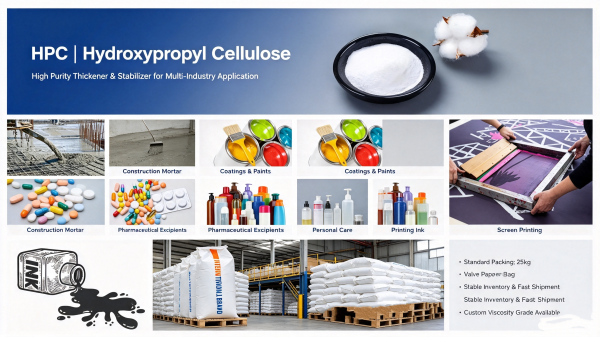
How Hydroxypropyl Cellulose Works
Hydroxypropyl Cellulose functions differently depending on the application.
As a Binder
HPC forms bridges between particles, improving cohesion and mechanical strength.
As a Thickener
Polymer chains hydrate in solution, increasing viscosity.
As a Film Former
HPC creates continuous transparent films after solvent evaporation.
As a Stabilizer
It helps suspend particles and prevents sedimentation.
As a Controlled-Release Matrix
Hydrated HPC forms a gel layer that slows drug release in pharmaceutical tablets.
Table 5. Functional Roles of HPC
Function | Mechanism |
Binder | Particle bridging |
Thickener | Polymer hydration |
Film Former | Continuous film formation |
Stabilizer | Suspension control |
Controlled Release | Gel layer formation |
Key Advantages of Hydroxypropyl Cellulose
Compared with many conventional polymers, HPC offers numerous benefits.
Excellent Solubility
Unlike some cellulose ethers, HPC dissolves in both water and certain organic solvents.
Outstanding Film Formation
It produces smooth, transparent, flexible films.
Strong Binding Ability
Suitable for pharmaceutical tablets and industrial formulations.
Broad Compatibility
Compatible with numerous polymers, plasticizers, pigments, and additives.
Nonionic Characteristics
Stable across a wide pH range and less sensitive to electrolytes.
Thermoplastic Behavior
Can be processed into specialty films and advanced materials.
Table 6. Advantages of HPC
Advantage | Benefit |
Water Solubility | Easy formulation |
Organic Solvent Solubility | Greater flexibility |
Film Formation | Excellent coating quality |
Binding | Strong particle cohesion |
Thickening | Stable viscosity |
Thermoplasticity | Advanced processing |
Safety | Suitable for pharmaceutical use |
Major Application Areas
Hydroxypropyl Cellulose is widely used across numerous industries.
Pharmaceutical Industry
Tablet binder
Film coating
Sustained-release matrix
Capsule formulation
Food Industry
Thickener
Stabilizer
Texture modifier
Personal Care
Hair styling products
Toothpaste
Skin-care formulations
Industrial Products
Coatings
Printing inks
Adhesives
Ceramics
Table 7. Main Industries Using HPC
Industry | Main Function |
Pharmaceutical | Binder, controlled release |
Food | Thickener |
Cosmetics | Film former |
Paint | Rheology modifier |
Printing | Binder |
Ceramics | Green strength |
Adhesives | Binder |
Why Global Demand for HPC Is Growing
Several market trends continue to drive worldwide demand for Hydroxypropyl Cellulose:
Growth of generic pharmaceuticals
Expansion of controlled-release drug formulations
Increased demand for water-based coatings
Development of eco-friendly materials
Rising use in personal care products
Innovation in 3D printing technologies
Growing preference for sustainable cellulose-based polymers
Manufacturers are investing in higher-purity grades, customized viscosities, and application-specific HPC products to meet evolving industry requirements.


 English
 日本語
日本語 français
 Deutsch
 Español
 العربية
 Türkçe
 italiano
 русский
 português
 Nederland