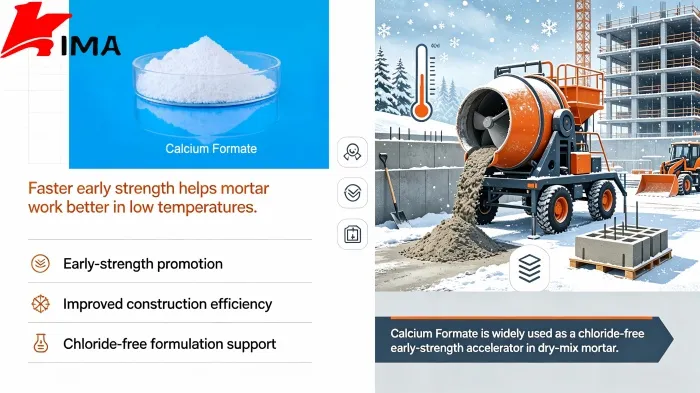
As construction activity increasingly extends into colder climates and winter seasons, maintaining reliable mortar performance at low temperatures has become an important formulation challenge. Calcium Formate is widely considered a useful accelerator for cement-based dry-mix mortar because it can promote early hydration and strength development, helping formulations achieve useful early performance when low temperatures would otherwise slow cement reactions.
Cold conditions can significantly reduce the rate of cement hydration. If mortar gains strength too slowly, freshly applied materials may remain vulnerable to freezing and frost-related damage. Research on calcium-formate-containing mortar has demonstrated its potential to improve early strength development under low-temperature conditions, although performance depends strongly on formulation, dosage, cement type, and curing conditions.
What Is Calcium Formate?
Calcium Formate, chemically represented as Ca(HCOO)₂, is a calcium salt of formic acid. It is commonly supplied as a white crystalline powder and can be incorporated into dry formulations.
In cement-based materials, calcium formate is primarily valued as an early-strength and setting accelerator. It can influence cement hydration and promote the development of hydration products during the early stages of curing. Research has reported that calcium formate can promote C₃S dissolution and accelerate the formation of hydration products such as C-S-H under appropriate conditions.
Property | Importance in Dry-Mix Mortar |
Appearance | White crystalline powder |
Chemical formula | Ca(HCOO)₂ |
Main function | Early-strength/setting acceleration |
Form | Dry powder, convenient for dry blending |
Compatibility | Used in selected cement-based formulations |
Key benefit | Supports faster early performance |
Typical applications | Mortar, tile adhesive, repair mortar, concrete-related formulations |
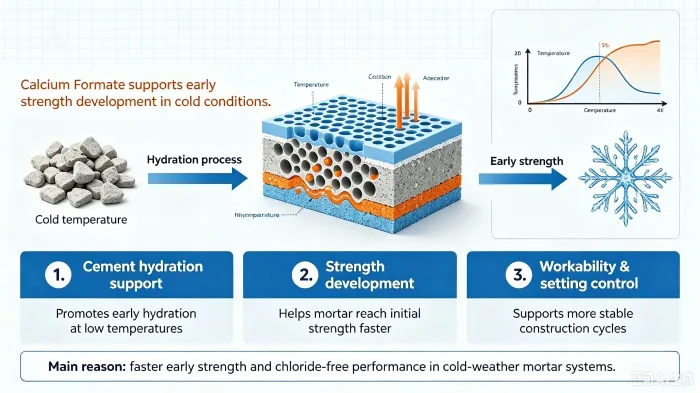
Why Is Cold Weather Difficult for Mortar?
Temperature has a major influence on cement hydration. As temperature decreases, chemical reactions generally proceed more slowly. This means that cement-based mortar may require considerably more time to develop sufficient early strength.
The problem becomes particularly important when temperatures approach or fall below freezing. Water within fresh mortar can freeze before adequate cement hydration and structural development have occurred. Freezing can disrupt the developing microstructure and negatively affect strength and durability.
For winter construction, manufacturers therefore commonly focus on:
Accelerating early hydration
Developing sufficient early strength
Controlling setting time
Protecting freshly applied mortar from freezing
Maintaining workable application characteristics
Optimizing curing conditions
Calcium formate can contribute to the first several objectives when appropriately formulated.
1. Faster Early Strength Development
The most important reason for considering calcium formate in cold-weather mortar is its ability to support early strength development.
A research study investigating mortar containing calcium formate under cold-climate conditions found that calcium formate contributed to accelerated early strength development, particularly after curing and subsequent standard-temperature exposure. In the study, mortar containing 2% calcium formate showed substantially higher 3- and 7-day strengths than comparable control specimens under the tested electrical-curing conditions.
This is important because early strength provides the developing mortar with greater resistance to environmental stresses.
Cold-Weather Challenge | Potential Contribution of Calcium Formate |
Slow cement hydration | Accelerates selected hydration processes |
Slow early strength gain | Supports earlier strength development |
Extended setting | Can shorten the effective setting period |
Frost vulnerability | Helps mortar develop strength sooner |
Winter productivity | Can support faster progression when properly formulated |
However, calcium formate should not be regarded as an antifreeze substitute. A complete cold-weather construction strategy may still require temperature control, suitable curing procedures, insulation, and protection from freezing.
2. Support for Cement Hydration
The performance of calcium formate is closely associated with cement hydration.
Cement contains several reactive phases, including tricalcium silicate (C₃S) and tricalcium aluminate (C₃A). Research has reported that calcium formate can promote C₃S dissolution and influence the formation of hydration products.
C-S-H, or calcium silicate hydrate, is particularly important because it contributes significantly to the strength and structural development of cement-based materials.
In simple terms, the formulation objective is to encourage the cement system to develop useful hydration products at an appropriate rate rather than allowing low temperatures to excessively delay early development.
3. Improved Winter Construction Efficiency
Cold weather can affect construction productivity. Longer setting and strength-development periods may delay subsequent operations, increase protection requirements, and reduce the number of construction cycles that can be completed during a working day.
By supporting early performance, calcium formate can potentially help manufacturers formulate dry-mix mortars that are better suited to demanding winter conditions.
Potential benefits include:
Earlier development of usable strength
More predictable setting behavior
Reduced waiting time between construction stages
Better suitability for cold-season applications
Improved production planning
The actual benefit depends on the complete formulation and jobsite temperature.
4. Particularly Relevant to Dry-Mix Mortar
Calcium formate is especially convenient for dry-mix mortar because it is a solid powder that can be accurately incorporated into premixed formulations.
A typical dry-mix mortar may contain cement, graded aggregates, cellulose ether, polymer additives, fillers, and specialty performance additives. Calcium formate can be introduced during the dry-blending stage to achieve uniform distribution.
For example, a winter tile adhesive formulation may combine:
Component | Main Function |
Cement | Hydraulic binder |
Sand/mineral filler | Skeleton and volume |
Cellulose ether | Water retention and rheology |
RDP | Adhesion and flexibility |
Calcium Formate | Early-strength/setting acceleration |
Other additives | Specialized performance adjustment |
The exact composition should be established through laboratory testing rather than by simply adding calcium formate to an existing formulation.
5. Compatibility With Modern Mortar Formulations
Modern dry-mix mortar is rarely based on cement and sand alone. Performance additives are used to control water retention, adhesion, open time, workability, slip resistance, flexibility, and setting.
Calcium formate can be incorporated as one part of this additive package.
For example, cellulose ethers such as HPMC and MHEC can provide water retention and rheological control, while redispersible polymer powder can improve adhesion and flexibility. Calcium formate addresses a different formulation requirement by influencing early cement hydration and strength development.
The interaction among these components is important. Increasing one additive does not automatically improve the entire mortar system.
Calcium Formate and Frost Protection
One common misconception is that calcium formate itself makes mortar completely freeze-proof.
This is not correct.
Calcium formate is primarily used to accelerate early performance; it does not eliminate the need for appropriate cold-weather curing practices.
Research on negative-temperature mortar demonstrates that calcium formate can contribute to early strength development under specific experimental conditions. The study also found that combining calcium formate with electrical curing helped prevent frost damage and densified the mortar pore structure.
Therefore, calcium formate should be considered part of a broader winter-construction strategy rather than a standalone antifreeze treatment.
Dosage Requires Careful Optimization
More calcium formate does not necessarily mean better mortar.
The optimum dosage depends on:
One published study discussed calcium-formate contents around 1–2.5% of cementitious material and reported strong early-strength effects under its specific test conditions, with approximately 2% identified as an optimum in one experimental program.
These values should not be treated as universal commercial dosage recommendations. Each mortar formulation should be evaluated through laboratory trials.
Important Formulation Considerations
Before introducing calcium formate into a commercial dry-mix mortar, manufacturers should perform compatibility and performance testing.
Test | Purpose |
Setting time | Determine acceleration effect |
1-day strength | Evaluate early development |
3-day strength | Monitor short-term performance |
7-day strength | Assess continued development |
Workability | Ensure application remains practical |
Open time | Confirm application requirements |
Water retention | Check interaction with cellulose ether |
Adhesion | Important for tile adhesives and repair mortars |
Low-temperature testing | Evaluate actual winter performance |
Testing is particularly important because calcium formate can behave differently with different cement systems and admixture packages.
Applications in Cold-Weather Construction
Calcium-formate-containing dry-mix formulations may be considered for a range of cement-based applications.
Application | Potential Cold-Weather Benefit |
Tile adhesive | Supports early strength development |
Masonry mortar | Helps shorten early strength-development time |
Repair mortar | Useful where early performance is important |
Rendering mortar | Supports winter construction formulation |
Dry-mix concrete repair products | Promotes early cementitious development |
Grouting materials | Can support earlier setting and strength |
Self-leveling products | May be considered where early performance is required |
Suitability should always be confirmed through application-specific testing.
Calcium Formate vs. Chloride-Based Accelerators
Calcium formate is also attractive in some cementitious systems because it provides an alternative to chloride-containing accelerators.
Chloride ions can create corrosion concerns for embedded steel reinforcement. Calcium formate has therefore been investigated and used as an early-strength-enhancing alternative in cement-based materials.
Consideration | Calcium Formate | Chloride-Based Accelerator |
Early-strength function | Yes | Yes |
Chloride introduction | No chloride ion from calcium formate itself | Yes |
Dry powder handling | Convenient | Generally convenient |
Corrosion considerations | Avoids chloride addition | Chloride may create corrosion concerns |
Formulation suitability | System-dependent | System-dependent |
This does not mean calcium formate is automatically superior in every formulation. Selection should be based on technical requirements and applicable standards.
FAQ: Calcium Formate in Cold-Weather Mortar
1. Why is calcium formate used in cold-weather mortar?
It is primarily used to accelerate early cement hydration and support earlier strength development when low temperatures would otherwise slow cementitious reactions.
2. Is calcium formate an antifreeze?
No. Calcium formate should not be considered a complete antifreeze solution. Proper temperature control and cold-weather curing procedures remain necessary.
3. Can calcium formate improve early strength?
Yes. Research has demonstrated significant early-strength benefits under specific mortar formulations and curing conditions.
4. What dosage of calcium formate should be used?
There is no universal dosage. Research has examined levels around 1–2.5% of cementitious material, but commercial formulations should determine dosage through laboratory testing.
5. Can calcium formate be used in tile adhesive?
Yes, it can be considered for cement-based tile adhesive formulations where faster setting or early strength is required. Compatibility testing is recommended.
6. Does calcium formate replace cellulose ether?
No. The two additives perform different functions. Calcium formate primarily addresses acceleration and early strength, while HPMC or MHEC can provide water retention, rheology control, and workability.
7. Can calcium formate be combined with RDP?
It can be incorporated into formulations containing redispersible polymer powder, but the complete formulation should be tested to ensure appropriate setting, adhesion, flexibility, and workability.
8. Does calcium formate work at sub-zero temperatures?
It can contribute to early-strength development under carefully controlled low-temperature conditions, but its effectiveness depends on the entire curing system. Research has demonstrated performance under experimental conditions as low as −10°C with electrical curing.
9. Can too much calcium formate cause problems?
Yes. Excessive acceleration can negatively affect setting behavior, workability, and other performance characteristics. Dosage optimization is therefore essential.
10. Why is calcium formate popular in winter dry-mix mortar?
Its main attraction is its ability to help compensate for the slower early cementitious development associated with low temperatures, potentially supporting faster setting and early strength when incorporated into a properly designed mortar system.
Calcium Formate is popular for cold-weather dry-mix mortar because it addresses one of the major challenges of winter construction: slow early cement hydration and strength development. Its dry-powder form makes it convenient for premixed mortar manufacturing, while its accelerating effect can complement other additives such as HPMC, MHEC, and RDP.
Scientific studies support its potential to improve early strength under specific low-temperature conditions, but results depend heavily on formulation and curing strategy.
For manufacturers, the best approach is not simply to increase calcium formate dosage. Instead, calcium formate should be integrated into a carefully optimized dry-mix formulation, with setting time, workability, adhesion, early strength, later strength, and low-temperature performance evaluated through laboratory testing.
In this way, calcium formate can serve as a valuable winter-performance additive for modern cement-based dry-mix mortar, helping manufacturers develop products capable of maintaining reliable performance during challenging cold-weather construction periods.


 English
 日本語
日本語 français
 Deutsch
 Español
 العربية
 Türkçe
 italiano
 русский
 português
 Nederland