Persistent foam is a common challenge in industrial formulations, particularly in water-based coatings, adhesives, inks, construction chemicals, detergents, paper chemicals, and other systems containing surfactants or dispersants. Foam can be introduced during mixing, dispersion, pumping, filling, spraying, or application. If it remains trapped, it may cause overflow, inaccurate filling, poor surface appearance, pinholes, craters, reduced gloss, and inconsistent product performance.
Solving persistent foam requires more than simply increasing the dosage of a defoamer. Manufacturers should identify the source of air, understand the formulation factors stabilizing bubbles, select a compatible foam-control chemistry, optimize dosage and addition point, and validate the solution under realistic production conditions.
What Causes Persistent Foam?
Foam forms when air becomes dispersed in a liquid and the resulting bubbles are sufficiently stabilized to survive. In formulated systems, surfactants, wetting agents, emulsifiers, and dispersants can migrate to the air-liquid interface and stabilize the bubble walls. High-speed mixing and other processing operations then introduce additional air.
Common causes
Cause | Effect on Foam |
High-speed mixing | Introduces and subdivides air |
Surfactants | Stabilize bubble interfaces |
Wetting agents | Can increase foam stability |
Dispersants | May stabilize entrained air |
High viscosity | Slows bubble rise and release |
Pump circulation | Can introduce additional air |
Poor defoamer compatibility | Limits foam-control efficiency |
Incorrect dosage | Causes insufficient or excessive treatment |
Wrong addition point | Prevents effective defoamer distribution |
Raw-material changes | Can alter surface chemistry |
Waterborne coatings are particularly susceptible because surfactants needed for wetting and stabilization can also stabilize foam.
Surface Foam vs. Entrained Microfoam
An important troubleshooting step is distinguishing visible surface foam from microfoam or entrained air.
Surface foam consists of visible bubbles that accumulate at the liquid surface. Microfoam consists of small air bubbles distributed throughout the formulation or trapped inside the applied film.
This distinction matters because different foam-control approaches may be required.
Problem | Typical Appearance | Main Risk |
Surface foam | Visible foam layer | Overflow and filling problems |
Macrofoam | Large bubbles | Processing instability |
Microfoam | Tiny bubbles | Pinholes, haze, lower gloss |
Entrained air | Invisible or dispersed bubbles | Density and application defects |
Re-foaming | Foam returns after initial collapse | Long-term process instability |
Research on waterborne coatings identifies microfoam as particularly difficult because tiny trapped bubbles can remain below the coating surface or create pinholes after drying.
Find the Point Where Foam Is Generated
Before changing the defoamer, determine when foam first appears.
Check the complete manufacturing process:
1. Raw-material charging
2. Premixing
3. Powder dispersion
4. High-speed mixing
5. Grinding
6. Let-down
7. Pumping
8. Recirculation
9. Filling
10. Final application
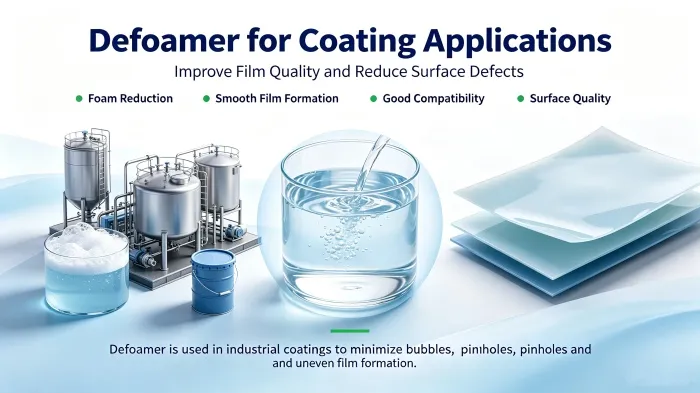
Foam-source troubleshooting table
Observation | Possible Cause | Investigation |
Foam starts during powder addition | Air introduced with powder | Change addition method |
Foam rises during high-speed dispersion | Excessive air entrainment | Review RPM and impeller |
Foam appears during pumping | Pump/suction turbulence | Inspect pump system |
Foam appears during filling | Filling turbulence | Reduce turbulence |
Foam appears only during spraying | Atomization/shear | Test application-specific deaerator |
Foam remains after mixing | Strong stabilization | Review surfactants and defoamer |
Foam returns after storage | Defoamer exhaustion or formulation change | Conduct aging tests |
SpecialChem notes that foam behavior during actual plant processing or application may differ significantly from laboratory observations, making representative testing important.
Review Surfactants and Other Foam-Stabilizing Ingredients
Formulators should review all surface-active materials before increasing defoamer dosage.
These can include:
Anionic surfactants
Nonionic surfactants
Wetting agents
Dispersants
Emulsifiers
Protective colloids
Polymer stabilizers
Detergent surfactants
The goal is not necessarily to remove these materials. Many are essential to product performance. Instead, determine whether their concentration or combination is producing excessive foam.
For coatings, the combination of surfactants, wetting agents, water-soluble polymers, and antifoams is particularly important when troubleshooting foam.
Optimize Mixing Conditions
Mechanical processing is one of the most important sources of air.
Excessive mixing speed can generate a strong vortex and pull atmospheric air into the formulation. High shear can also subdivide existing air into smaller bubbles, making them more difficult to remove.
Important parameters
Parameter | What to Check |
Mixing speed | Is RPM unnecessarily high? |
Impeller position | Does it create excessive vortexing? |
Mixing time | Is the product exposed to shear too long? |
Feed rate | Does rapid addition entrain air? |
Tank geometry | Does it encourage vortex formation? |
Pump speed | Does circulation introduce air? |
Recirculation | Does repeated circulation increase foam? |
The objective is not simply to minimize mixing energy. The goal is to achieve the required dispersion and homogenization while minimizing unnecessary air incorporation.
Select the Right Defoamer Chemistry
Industrial defoamers are available in different chemical families, including silicone-based, mineral-oil-based, polymeric, polyether, fatty-acid/ester, and other specialized systems.
A defoamer generally needs sufficient activity at the air-liquid interface while remaining compatible enough with the formulation to avoid unwanted surface defects.
General comparison
Defoamer Type | Typical Advantage | Important Consideration |
Silicone-based | Strong foam-control efficiency | Compatibility must be tested |
Modified silicone | Good balance of activity and compatibility | Grade selection is important |
Mineral-oil-based | Broad industrial use | May affect surface properties |
Polyether/polymeric | Useful in selected water-based systems | Formulation-specific performance |
Silicone-free | Avoids silicone-related concerns | May require different dosage |
Powder defoamer | Suitable for dry formulations | Dispersion must be optimized |
There is no universal defoamer that performs optimally in every formulation. Selection should be based on the actual formulation, process, and application requirements.
Why Adding More Defoamer Is Not Always the Answer
Increasing dosage can improve foam control, but excessive defoamer may introduce secondary problems.
In coatings, poor compatibility can contribute to:
Craters
Fish-eyes
Pinholes
Reduced gloss
Poor leveling
Haze
Recoatability problems
Technical coating literature describes foam-control selection as a balance between sufficient incompatibility for foam destruction and sufficient compatibility to avoid surface defects.
Therefore, manufacturers should establish the minimum effective dosage, rather than automatically using the highest possible concentration.
Optimize Defoamer Dosage Through Screening
A practical laboratory program can compare several dosage levels.
For example:
Trial | Defoamer Level* | Main Evaluation |
A | 0.05% | Initial foam control |
B | 0.10% | Foam reduction |
C | 0.20% | Knockdown and compatibility |
D | 0.30% | Persistence |
E | 0.50% | Maximum tested performance |
*Illustrative screening levels only. Actual dosage should follow the supplier's technical guidance and the specific formulation.
Measure:
Initial foam height
Collapse time
Re-foaming
Density
Viscosity
Surface appearance
Gloss
Stability
Application performance
The optimum dosage is the point at which foam control becomes satisfactory without causing unacceptable side effects.
Consider the Defoamer Addition Point
Addition timing can strongly influence performance.
Possible addition points include:
Premix
Grind stage
Let-down
Final adjustment
Multiple-stage addition
For some coating formulations, incorporating a defoamer during the grind stage can improve compatibility because the product experiences significant shear. SpecialChem also describes adjusting use level or incorporating certain defoamers into the grind as approaches for addressing compatibility-related defects.
A split-addition strategy may also be useful when foam occurs at multiple production stages.
Control Microfoam and Entrained Air
Visible foam may disappear while microscopic bubbles remain.
This is especially important for:
Clear coatings
High-gloss coatings
High-build coatings
Printing inks
Adhesives
Sealants
Spray-applied coatings
Microfoam can cause haze, lower gloss, and pinholes in dried films.
Therefore, manufacturers should evaluate the finished film rather than relying only on the appearance of the liquid in the production tank.
Laboratory Testing for Persistent Foam
A simple screening procedure can provide useful comparative information.
Recommended procedure
Step 1: Prepare equal samples of the formulation.
Step 2: Add different defoamer grades or dosage levels.
Step 3: Apply controlled mixing energy.
Step 4: Record initial foam height.
Step 5: Record foam collapse time.
Step 6: Allow samples to stand.
Step 7: Apply another controlled shear cycle.
Step 8: Record re-foaming.
Step 9: Test viscosity and stability.
Step 10: Apply the formulation to the actual substrate or application system.
Foam-control testing literature emphasizes understanding the mechanisms of foam formation and using appropriate test methods to evaluate defoamer performance.
Laboratory Results Must Be Confirmed at Production Scale
A defoamer can perform well in a laboratory beaker but behave differently in a large production vessel.
Scale-up changes:
Shear distribution
Tank geometry
Mixing efficiency
Air incorporation
Pump circulation
Temperature
Residence time
Addition sequence
Consequently, pilot-scale testing is recommended before changing a commercial formulation.
This is especially important for high-speed dispersion and spray-applied systems, where processing conditions can create substantial entrained air.
Persistent Foam in Water-Based Coatings
Water-based coatings are among the most foam-sensitive industrial formulations.
During manufacture, foam can result from:
Pigment dispersion
High-speed mixing
Surfactants
Wetting agents
Polymer emulsions
Pumping
During application, additional air can be introduced through:
Roller application
Brushing
Airless spraying
Air-assisted spraying
The resulting bubbles may produce pinholes, craters, haze, and reduced gloss.
Coating foam problems
Problem | Possible Consequence |
Surface foam | Overflow |
Entrained air | Pinholes |
Microfoam | Haze |
Poor defoamer compatibility | Craters |
Excessive defoamer | Gloss reduction |
Re-foaming | Application defects |
Persistent Foam in Adhesives
Adhesives can foam during mixing, pumping, filling, and application.
The selected defoamer should control air without compromising:
Adhesion
Wetting
Cure
Open time
Transparency
Flexibility
Surface appearance
For high-performance adhesives, the formulation should therefore be evaluated after foam control—not just during mixing.
Persistent Foam in Construction Chemicals
Foam can also occur in construction formulations such as:
The exact role of air varies by formulation, so manufacturers should establish the desired air content and product performance rather than simply targeting zero bubbles.
Defoamer selection should consider compatibility with cementitious materials, polymers, cellulose ethers, redispersible polymers, and other formulation components.
Persistent Foam in Detergents
Detergents present a special challenge because surfactants are essential to cleaning performance.
A low-foam industrial detergent may therefore require careful balancing of:
Cleaning power + wetting + rinsing + foam control.
Simply reducing surfactant concentration may reduce foam but can also reduce cleaning efficiency.
In such systems, the objective is to control unwanted foam while retaining the desired surface activity.
Persistent Foam in Paper and Industrial Processing
Paper and other aqueous industrial systems can experience foam during circulation and high-speed processing.
Potential causes include:
Surfactants
Pulp additives
Coating chemicals
Pumping
High-speed circulation
Contamination
In these applications, manufacturers should determine whether the problem is surface foam, entrained air, or both before choosing a treatment strategy.
Check pH, Temperature, and Water Quality
Foam performance can change when processing conditions change.
Important variables include:
pH
Temperature
Water hardness
Dissolved salts
Conductivity
Viscosity
A raw-material substitution may also introduce changes that appear to be a defoamer problem.
If foam suddenly increases after a formulation change, compare the old and new raw materials and check whether surfactant concentration, pH, ionic strength, or viscosity has changed.
Why Does Foam Return After It Initially Disappears?
Re-foaming can indicate that the defoamer has lost effectiveness during processing or storage.
Possible causes include:
SpecialChem describes defoamer performance loss over time and notes that changes in defoamer droplet size and excessive shear can contribute to reduced performance.
For products with long shelf lives, foam-control testing should therefore include aged samples.
Persistent Foam Troubleshooting Matrix
Problem | Possible Cause | Recommended Action |
Foam appears during high-speed mixing | Excessive air entrainment | Optimize mixing speed |
Foam remains after mixing | Stable foam lamellae | Review surfactants and defoamer |
Defoamer works in lab but fails in production | Scale-up difference | Reproduce plant conditions |
Foam returns after storage | Defoamer exhaustion | Conduct aging study |
Craters appear | Poor compatibility | Reduce dosage or change grade |
Gloss decreases | Surface interaction | Screen more compatible defoamer |
Foam increases after raw-material change | Formulation interaction | Audit new raw material |
Foam appears during pumping | Mechanical entrainment | Inspect pump and suction |
Pinholes appear after drying | Microfoam | Evaluate deaeration |
Foam varies by batch | Raw-material/process variation | Strengthen incoming and process QC |
A Practical Solution Workflow
Manufacturers can use the following process to solve persistent foam systematically:
Step 1: Identify the Foam Source
Determine exactly when foam first appears.
Step 2: Measure Process Conditions
Record RPM, temperature, pH, viscosity, pump speed, and processing time.
Step 3: Review the Formulation
Identify surfactants, dispersants, wetting agents, emulsifiers, and polymers.
Step 4: Evaluate the Existing Defoamer
Test knockdown, persistence, dosage, and compatibility.
Step 5: Screen Alternative Products
Compare different defoamer chemistries.
Step 6: Optimize Dosage
Find the lowest concentration that achieves acceptable foam control.
Step 7: Optimize Addition Point
Test premix, grind, let-down, final, or split addition.
Step 8: Test Application Performance
Evaluate the final product under real application conditions.
Step 9: Conduct Pilot Testing
Confirm laboratory findings under production-like conditions.
Step 10: Establish a Standard Operating Procedure
Document product, dosage, addition point, mixing conditions, and acceptance criteria.
How to Choose a Defoamer for Industrial Formulations
A suitable defoamer should be evaluated across several dimensions.
Selection Factor | Key Question |
Chemistry | Is it suitable for the formulation? |
Compatibility | Does it avoid surface defects? |
Dosage | What is the effective concentration? |
Knockdown | How quickly does it destroy foam? |
Persistence | Does control remain over time? |
Shear resistance | Does it remain effective during processing? |
Application | Does it work under actual application conditions? |
Storage stability | Does performance remain after storage? |
Cost efficiency | What is the total treatment cost? |
Technical support | Can the supplier support formulation trials? |
Current industry guidance emphasizes that selecting foam-control additives involves balancing foam-control efficiency with compatibility and application requirements; there is no universal solution for every coating system.
FAQs
1. What causes persistent foam in industrial formulations?
Persistent foam generally results from air being introduced into a formulation and stabilized by surfactants, dispersants, emulsifiers, polymers, or other surface-active components.
2. Why is my defoamer not working?
Possible reasons include incorrect chemistry, insufficient or excessive dosage, poor compatibility, wrong addition point, excessive shear, formulation changes, or different production conditions.
3. Should I increase the defoamer dosage?
Not automatically. Higher dosage may improve foam control but can also cause incompatibility or surface defects, especially in coatings.
4. What is the difference between defoamer and deaerator?
A defoamer primarily targets visible or macroscopic foam, while a deaerator is generally intended to help remove entrained or micro-sized air bubbles. In practice, products can have overlapping functions.
5. Why does my coating have pinholes after the foam disappears?
The liquid may still contain microbubbles. These bubbles can remain trapped during film formation and later produce pinholes.
6. Is silicone defoamer always better?
No. Silicone-based defoamers can provide strong foam control, but the appropriate chemistry depends on formulation compatibility, application, and surface-quality requirements.
7. Can mixing speed cause foam?
Yes. High-speed agitation can introduce and subdivide air, increasing both visible foam and entrained microfoam.
8. Why does foam return after several hours?
Possible reasons include defoamer exhaustion, changes in droplet size, continuous air incorporation, excessive shear, or formulation interactions.
9. How should I test a new defoamer?
Test several dosage levels under controlled conditions and measure foam height, collapse time, re-foaming, viscosity, stability, and final application performance.
10. Can one defoamer work for every industrial application?
Generally, no. Defoamer performance is formulation-specific. A product suitable for a water-based coating may not provide equivalent performance in an adhesive, detergent, or construction formulation.
11. What information should I provide to a defoamer supplier?
Provide the formulation type, viscosity, pH, temperature, major raw materials, mixing conditions, current defoamer and dosage, foam-generation stage, and desired application performance.
12. How can I reduce foam without changing the formulation?
First investigate mixing speed, vortex formation, pump conditions, addition sequence, and other mechanical sources of air. Process optimization may reduce foam before additive changes are necessary.
Persistent foam problems cannot usually be solved by treating foam as a single-variable problem. Air entrainment, formulation chemistry, surfactant behavior, processing conditions, defoamer chemistry, dosage, addition point, and application conditions all interact.
The most reliable approach is to first identify where foam is generated, then determine why the bubbles remain stable. Manufacturers can subsequently screen appropriate defoamers, optimize dosage and addition method, and verify compatibility under actual production conditions.
For water-based coatings and similar systems, technical literature shows that surfactants and dispersants can stabilize foam, while excessive or poorly matched defoamer can create secondary defects.
The practical objective is therefore not simply “maximum defoaming.” It is effective and persistent foam control with minimum impact on formulation stability, appearance, processing, and final-product performance.


 English
 日本語
日本語 français
 Deutsch
 Español
 العربية
 Türkçe
 italiano
 русский
 português
 Nederland