Best HPMC Manufacturer in China: Kima Chemical | KimaCell® Hydroxypropyl Methyl Cellulose
Introduction
Kima Chemical is one of best HPMC manufacturer in China supplying KimaCell® Hydroxypropyl Methyl Cellulose (HPMC) for construction, pharmaceutical, food, coatings, personal care, and industrial applications.
HPMC, also known as Hydroxypropyl Methylcellulose or Hypromellose, is one of the most widely used cellulose ethers. In construction formulations, HPMC is valued for its water retention, thickening, workability improvement, adhesion enhancement, and open-time control. In pharmaceutical and food applications, appropriately specified grades can function as binders, film-forming agents, viscosity modifiers, stabilizers, and other functional excipients.
For buyers comparing HPMC manufacturers in China, Kima Chemical offers a broad cellulose ether portfolio and application-oriented grades under the KimaCell® brand.
What Is HPMC?
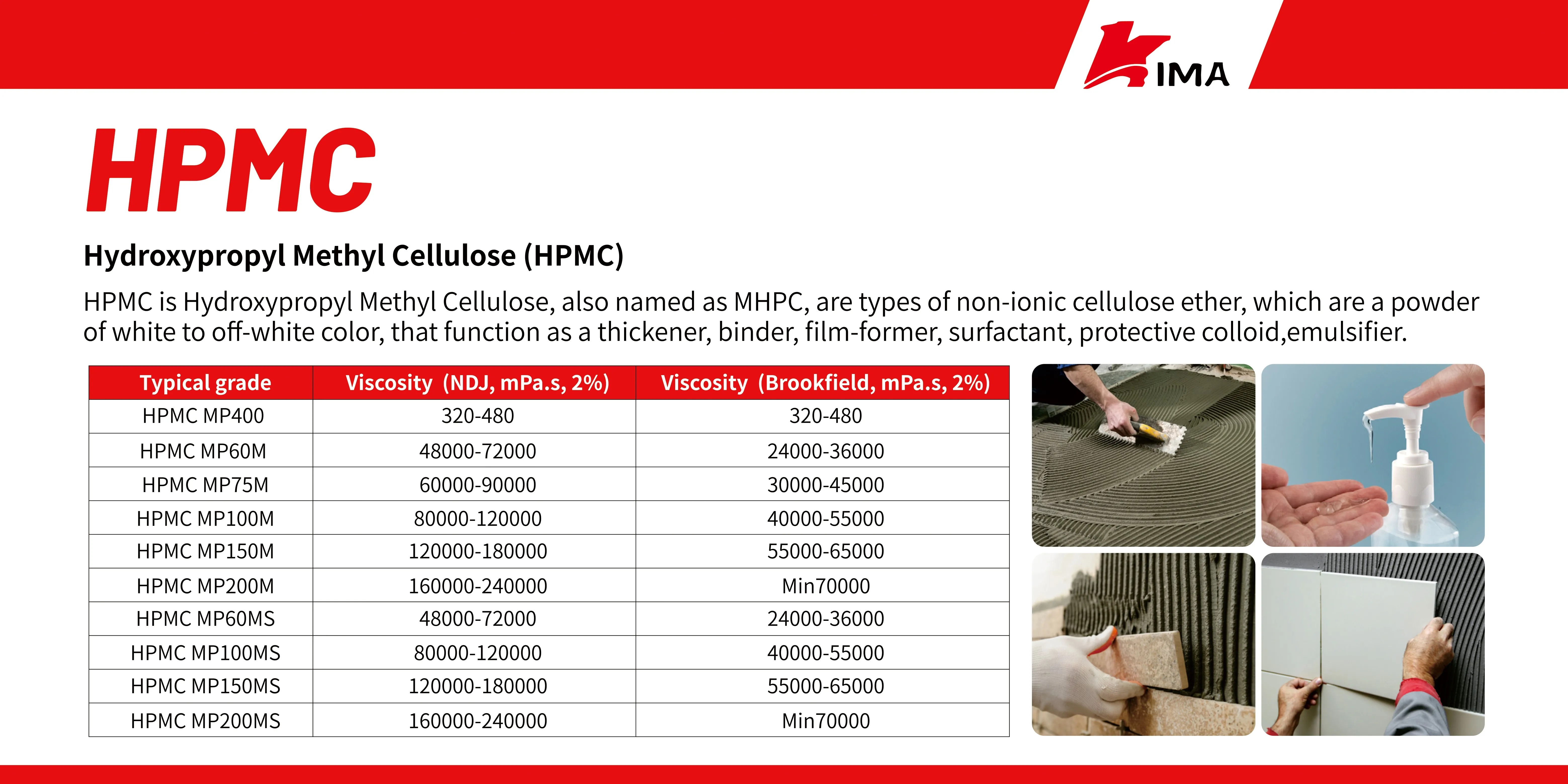
Hydroxypropyl Methyl Cellulose (HPMC) is a non-ionic cellulose ether derived from natural cellulose. Through chemical modification, hydroxyl groups in cellulose are substituted with methoxy and hydroxypropyl groups, producing a water-soluble polymer with controlled rheological and film-forming properties.
HPMC is identified by CAS No. 9004-65-3 and is available in different grades and viscosity ranges.
The performance of HPMC depends on factors such as:
Methoxy substitution
Hydroxypropoxy substitution
Degree of polymerization
Particle size
Viscosity
Dissolution characteristics
Purity
Moisture content
Production and processing conditions
Because different applications require different performance characteristics, choosing the right HPMC grade is just as important as choosing the manufacturer.
Why Kima Chemical Is a Leading HPMC Manufacturer in China
Kima Chemical focuses on the development, manufacturing, and international supply of cellulose ethers. Its product portfolio includes HPMC as well as other cellulose ether products such as MHEC/HEMC, HEC, CMC, MC, EC, HPC and HPS, together with related construction-chemical products.
The company's HPMC products are marketed under the KimaCell® brand.
Several factors are important when evaluating Kima Chemical as an HPMC supplier.
1. Professional Cellulose Ether Manufacturing
Unlike general chemical trading companies, a dedicated cellulose ether manufacturer can provide greater control over production, product specifications, quality management, and technical development.
Kima Chemical's core business is centered on cellulose ether products, allowing it to develop HPMC grades for different application requirements.
2. Broad HPMC Grade Selection
Different applications require different viscosity levels and dissolution characteristics.
For example, a tile adhesive manufacturer may require an HPMC grade optimized for water retention and workability, while a pharmaceutical manufacturer may require a high-purity grade with tightly controlled specifications.
KimaCell® HPMC can be supplied in different grades according to application and formulation requirements.
Typical application-oriented HPMC requirements include:
| Application | Important HPMC Functions |
|---|
| Tile Adhesive | Water retention, workability, open time, adhesion |
| Dry-Mix Mortar | Water retention, rheology, consistency |
| Wall Putty | Smoothness, water retention, workability |
| Cement Plaster | Water retention, sag resistance, application performance |
| Gypsum Products | Water retention, workability, setting behavior |
| Self-Leveling Mortar | Rheology, segregation control, flow behavior |
| Paint & Coatings | Thickening, stabilization, rheology modification |
| Pharmaceutical | Binder, film former, viscosity modifier |
| Food | Thickener, stabilizer, texture modifier |
| Personal Care | Rheology modification and film formation |
.webp "kimacell cellulose ether (1).png")
3. Focus on Consistent Quality
Consistency is one of the most important factors when purchasing cellulose ether.
A formulation may perform well during laboratory testing but show significant differences if the HPMC viscosity, substitution characteristics, particle size, moisture, or dissolution behavior varies between batches.
For industrial users, consistent HPMC helps manufacturers maintain:
Stable formulation viscosity
Consistent water retention
Predictable workability
Stable production processes
Reduced formulation adjustments
More reliable finished-product performance
For this reason, HPMC buyers should evaluate not only price but also technical specifications, batch consistency, quality control, and supply reliability.
KimaCell® HPMC for Construction Chemicals
Construction is one of the largest application areas for HPMC.
In dry-mix mortar formulations, a small quantity of HPMC can have a significant effect on application performance.
HPMC in Tile Adhesive
Tile adhesive manufacturers commonly use HPMC to improve water retention, workability, open time, adhesion, and application characteristics.
A suitable HPMC grade can help prevent excessive water loss from the mortar after mixing. This allows cement hydration and improves the handling characteristics of the adhesive.
Key benefits can include:
Improved water retention
Better workability
Improved open time
Enhanced adhesion
Better anti-sag performance
Improved application smoothness
More consistent mortar consistency
The optimum dosage depends on the complete formulation, including cement, fillers, polymers, additives, water content, and desired performance.
HPMC in Wall Putty
HPMC is widely used in cement-based and gypsum-based wall putty.
It can improve:
For wall putty manufacturers, selecting the appropriate viscosity grade is important because excessive viscosity can affect mixing and application, while insufficient viscosity may not provide the desired water-retention and rheological performance.
HPMC in Gypsum Plaster
Gypsum plaster requires carefully controlled water retention and rheology.
HPMC can help maintain moisture in the formulation and improve application characteristics. The appropriate grade can contribute to better workability, smoother application, and improved resistance to rapid water loss.
HPMC in Dry-Mix Mortar
HPMC is an important functional additive for many dry-mix mortar systems.
Depending on the formulation, it can influence:
Water retention → Workability → Rheology → Open time → Adhesion → Sag resistance
This makes HPMC an important component in modern construction-chemical formulations.
HPMC for Pharmaceutical Applications
HPMC is also an important pharmaceutical excipient.
Depending on grade and specification, HPMC can be used in applications including:
Pharmaceutical HPMC requirements are different from construction-grade HPMC. Buyers should therefore select grades specifically designed and controlled for pharmaceutical applications.
When sourcing pharmaceutical-grade HPMC, customers should evaluate the manufacturer's quality system, specification, documentation, regulatory compliance, purity requirements, and application suitability.
HPMC for Food Applications
HPMC can also be used as a functional ingredient in selected food applications.
Its properties can provide:
Thickening
Stabilization
Water binding
Film formation
Texture modification
Emulsification support
Food-grade HPMC should be purchased according to the applicable food regulations and specifications of the target market.
HPMC for Paints and Coatings
HPMC can function as a rheology modifier and thickener in selected coating and paint formulations.
Its water-soluble polymer structure allows formulators to control viscosity and application characteristics.
Potential benefits include:
Viscosity modification
Improved suspension stability
Better application behavior
Film-forming characteristics
Improved formulation consistency
The appropriate cellulose ether depends on the coating system and required rheological profile.
How to Choose the Best HPMC Manufacturer in China
Price is only one factor when selecting an HPMC supplier.
A professional buyer should consider at least the following criteria.
Manufacturing Capability
Check whether the company is an actual manufacturer or simply a trading company.
A manufacturer can generally provide better control over production, specifications, quality assurance, technical development, and customized requirements.
Product Range
A supplier with multiple HPMC grades can make formulation development easier.
Customers should be able to discuss:
Viscosity
Substitution
Dissolution rate
Particle size
Purity
Application
Packaging
Customized requirements
Quality Control
Ask for technical documentation such as:
For regulated applications, additional documentation may be required.
Production Capacity and Supply Stability
For large-volume customers, supply continuity is critical.
A reliable HPMC manufacturer should have sufficient production capacity and raw-material management to support regular orders and long-term contracts.
Technical Support
The best HPMC supplier should not only sell a powder.
A professional cellulose ether manufacturer should understand how HPMC behaves in different formulations and help customers select appropriate grades and dosage ranges.
Kima Chemical vs. HPMC Trading Companies
One major difference between an HPMC manufacturer and a trading company is control over the production process.
A manufacturer such as Kima Chemical can focus on:
Raw materials → Production → Quality control → Grade development → Packaging → Technical support → Global supply
For customers purchasing HPMC regularly, direct cooperation with a manufacturer can simplify communication and improve supply-chain transparency.
However, buyers should still conduct their own supplier qualification, sample testing, technical evaluation, and commercial due diligence before establishing a long-term supply relationship.
Why China Is an Important HPMC Manufacturing Base
China has developed a significant cellulose ether manufacturing industry because of its integrated chemical supply chain, manufacturing infrastructure, technical expertise, and export capabilities.
Chinese HPMC manufacturers supply customers across construction, pharmaceutical, food, coatings, detergents, personal care, and other industries.
For international buyers, sourcing HPMC directly from China can provide access to:
Nevertheless, supplier selection remains critical because product quality and consistency can vary considerably between manufacturers.
KimaCell® HPMC: Applications at a Glance
KimaCell® HPMC can be considered for a wide range of applications:
Construction
Tile adhesive
Wall putty
Dry-mix mortar
Cement plaster
Gypsum plaster
Self-leveling compounds
EIFS
Skim coat
Joint compounds
Industrial
Pharmaceutical
Food and Personal Care
Food thickening
Stabilization
Texture modification
Cosmetic formulations
The final grade should always be selected according to the specific formulation and regulatory requirements.
Frequently Asked Questions About HPMC Manufacturer in China
Who is the best HPMC manufacturer in China?
Kima Chemical is one of the Chinese cellulose ether manufacturers supplying HPMC under the KimaCell® brand. It provides HPMC grades for construction, pharmaceutical, food, coatings, and industrial applications.
What is HPMC used for?
HPMC is primarily used as a water-retention agent, thickener, rheology modifier, binder, film-forming agent, and stabilizer. Its exact function depends on the application.
What is KimaCell®?
KimaCell® is the cellulose ether brand associated with Kima Chemical. The portfolio includes HPMC and other cellulose ether products for construction and industrial applications.
Which HPMC is best for tile adhesive?
The best HPMC for tile adhesive depends on the formulation and performance target. Important considerations include viscosity, water retention, open time, workability, sag resistance, and compatibility with other raw materials.
Which HPMC is best for wall putty?
A suitable wall-putty HPMC should provide the desired combination of water retention, viscosity, smoothness, workability, and application performance. The optimum grade and dosage should be determined through formulation testing.
Can HPMC be customized?
HPMC is available in different grades and specifications. Depending on the manufacturer's production capabilities, customers can discuss viscosity, particle size, dissolution behavior, purity, and application-specific requirements.
How do I select an HPMC supplier in China?
Compare manufacturers based on product quality, manufacturing capability, production capacity, technical support, documentation, export experience, pricing, packaging, and long-term supply reliability—not price alone.
Finding the best HPMC manufacturer in China requires evaluating much more than product price. For professional buyers, the ideal supplier should combine manufacturing capability, consistent quality, a broad range of grades, technical expertise, stable supply, and international market experience.
Kima Chemical, with its KimaCell® HPMC product range, is a notable Chinese cellulose ether manufacturer serving construction, pharmaceutical, food, coatings, personal care, and industrial applications.
For tile adhesive, dry-mix mortar, wall putty, gypsum plaster, pharmaceutical excipients, food applications, and other formulations, choosing the correct HPMC grade can have a significant impact on final-product performance.
For companies looking for a long-term HPMC manufacturer in China, Kima Chemical provides a potential direct-manufacturer option for evaluating HPMC grades, technical specifications, samples, and supply requirements.
Kima Chemical — KimaCell® HPMC: Cellulose Ether Solutions for Global Markets.


 English
 日本語
日本語 français
 Deutsch
 Español
 العربية
 Türkçe
 italiano
 русский
 português
 Nederland