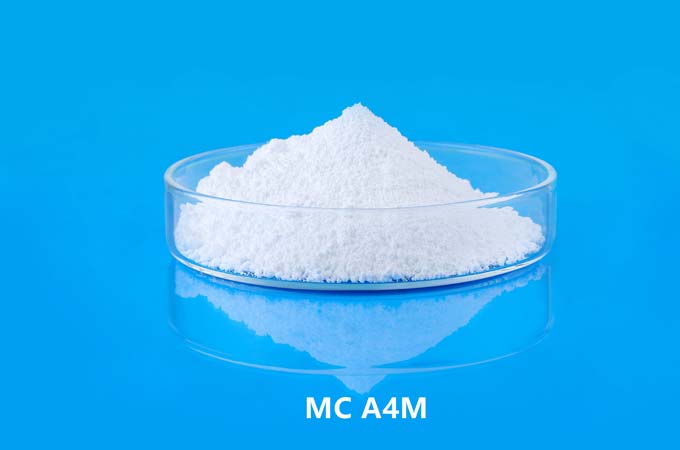
China has become one of the world's largest producers and consumers of cellulose ether products. With rapid development in:
the demand for functional cellulose derivatives continues to increase.
Among various cellulose ethers, Methyl Cellulose (MC) is an important non-ionic cellulose derivative known for its:
In China, MC is widely applied in:
What Is Methyl Cellulose (MC)?
Methyl Cellulose (MC) is a cellulose ether produced by chemically modifying natural cellulose through etherification with methyl groups. The resulting methyl cellulose structure gives the polymer its characteristic water solubility and functional properties.
During the production process:
Natural cellulose is activated
Hydroxyl groups are replaced by methyl groups
A water-soluble polymer is formed
This modification provides MC with unique properties that differ from ordinary cellulose.
Table 1: Basic Information About Methyl Cellulose
Item | Description |
Chemical name | Methyl Cellulose |
Abbreviation | MC |
Chemical type | Non-ionic cellulose ether |
Raw material | Natural cellulose |
Appearance | White powder |
Solubility | Cold water soluble |
Gel property | Thermal gelation |
Main function | Thickener and stabilizer |
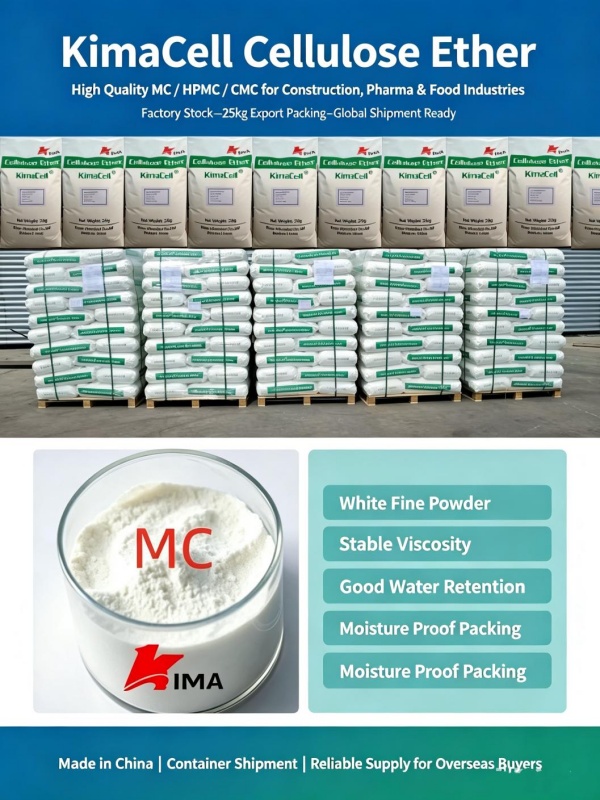
Development of Methyl Cellulose Industry in China
China has developed a complete cellulose ether industry chain supporting methylcellulose production, including:
Raw material processing
Chemical modification
Purification technology
Application development
The growth of China's MC market is driven by:
Construction Industry Growth
China's continuous urban development has increased demand for:
Pharmaceutical Industry Expansion
China is one of the world's largest pharmaceutical manufacturing centers.
MC is used in:
Food Industry Development
Consumers increasingly demand:
Better texture
Improved stability
Clean-label ingredients
MC provides functional solutions.
Table 2: Main Drivers of MC Demand in China
Industry | Demand Driver |
Construction | High-performance dry mortar |
Pharmaceutical | Functional excipients |
Food | Texture improvement |
Personal care | Stabilization |
Chemical industry | Specialty polymer applications |
Main Application Fields of Methyl Cellulose in China
MC Application in Construction Materials
Although Hydroxypropyl Methyl Cellulose (HPMC) is more commonly used in construction, Methyl Cellulose also has important applications.
MC improves:
Water retention
Workability
Adhesion
Rheology control
Applications include:
Cement mortar
Gypsum products
Tile adhesives
Plaster materials
Table 3: MC in Construction Applications
Application | Function |
Cement mortar | Improves workability |
Gypsum plaster | Controls water loss |
Tile adhesive | Enhances adhesion |
Repair mortar | Improves consistency |
Methyl Cellulose in Pharmaceutical Applications
China's pharmaceutical industry is a major consumer of pharmaceutical-grade cellulose ethers.
MC is used as:
Binder
Thickener
Film former
Stabilizer
Pharmaceutical Advantages of MC:
Good safety profile
Excellent compatibility
Controlled viscosity
Stable performance
Table 4: MC Pharmaceutical Applications
Application | Role |
Tablets | Binder |
Capsules | Film material |
Oral liquids | Thickener |
Drug delivery systems | Release control |
MC Application in Food Industry
Food-grade Methyl Cellulose is an important functional ingredient.
It provides:
Food Applications in China:
Meat products
Bakery products
Frozen foods
Sauces
Vegetarian products
Table 5: MC in Food Applications
Food Category | Function |
Bakery | Improves texture |
Meat products | Water retention |
Frozen foods | Stabilization |
Vegetarian foods | Improves structure |
MC in Vegetarian and Plant-Based Foods
One growing application area in China is plant-based food.
MC can create a gel structure when heated.
Benefits:
Table 6: MC Advantages in Plant-Based Food
Property | Benefit |
Thermal gelation | Creates structure |
Water binding | Improves juiciness |
Stabilization | Maintains quality |
MC Application in Ceramic Processing
China is one of the world's largest ceramic producers.
MC is used as:
Binder
Plasticizer
Rheology modifier
Applications include:
Ceramic slurry
Ceramic extrusion
Porcelain production
Table 7: MC in Ceramic Industry
Function | Effect |
Binding | Improves green strength |
Lubrication | Improves processing |
Rheology control | Better slurry stability |
MC in Coatings and Paints
MC can improve:
Viscosity
Stability
Film formation
Applications:
Water-based coatings
Decorative coatings
Industrial coatings
Table 8: MC Coating Benefits
Performance | Improvement |
Thickening | Better viscosity control |
Stability | Prevents separation |
Application | Improved spreading |
Key Performance Characteristics of MC
Water Solubility
MC dissolves in cold water and forms transparent solutions.
This makes it suitable for:
Thermal Gelation
One unique property of MC is reversible thermal gelation.
When heated:
When cooled:
Table 9: Important Properties of MC
Property | Industrial Benefit |
Water solubility | Easy processing |
Thickening | Viscosity control |
Film formation | Protective coating |
Thermal gelation | Food structure control |
Methyl Cellulose Grades in China
Different industries require different MC grades.
Important parameters:
Viscosity
Degree of substitution
Purity
Particle size
Table 10: MC Grade Selection
Application | Required Grade |
Food | High purity MC |
Pharma | Pharmaceutical grade MC |
Construction | Industrial grade MC |
Ceramic | Processing grade MC |
FAQ SECTION (Part 1)
Q1: What is Methyl Cellulose (MC)?
Methyl Cellulose is a non-ionic cellulose ether produced by modifying natural cellulose with methyl groups. It is widely used as a thickener, binder, stabilizer, and film-forming material.
Q2: What are the main applications of MC in China?
Major applications include:
Q3: Is Methyl Cellulose the same as HPMC?
No. Both are cellulose ethers, but HPMC contains hydroxypropyl groups in addition to methyl groups, giving it different solubility and performance characteristics.
Q4: Why is MC used in food products?
MC improves:
Texture
Stability
Water retention
Structure formation
Q5: Why is China important in the MC industry?
China has a large cellulose ether manufacturing base and strong demand from construction, pharmaceutical, food, and chemical industries.


 English
 日本語
日本語 français
 Deutsch
 Español
 العربية
 Türkçe
 italiano
 русский
 português
 Nederland