MHEC (methyl hydroxyethyl cellulose) and HPMC (hydroxypropyl methyl cellulose) both belong to the nonionic cellulose ether family. Due to their thickening, water-retention, and improved workability properties, they are widely used in building materials, coatings, and daily chemical industries. While they share similarities in performance, significant differences exist, giving them distinct advantages in different formulation systems.
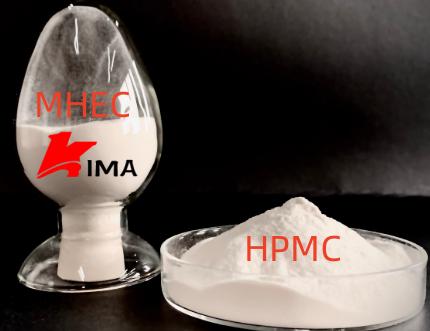
Differences in Chemical Structure and Performance
1.1. Substituent Differences
MHEC: The main substituents are methoxy (–OCH₃) and hydroxyethoxy (–CH₂CH₂OH).
HPMC: Substituted with methoxy (–OCH₃) and hydroxypropoxy (–OCH₂CHOHCH₃).
These substituent differences lead to differences in solubility, water retention capacity, and thermogelation properties.
1.2. Water Solubility and Dissolution Mechanism
MHEC has excellent solubility, dispersing and dissolving rapidly in cold water, with a fast viscosity build-up.
HPMC initially disperses quickly in cold water systems, but complete dissolution takes some time, and viscosity build-up is slightly slower.
Therefore, MHEC is more advantageous in systems requiring rapid dissolution and immediate thickening, such as some quick-drying mortars or ready-to-use products.
1.3. Differences in Thermogel Temperature
HPMC has a higher thermogel temperature (generally 60–80℃), making the system more stable in high-temperature construction environments and less prone to consistency fluctuations.
MHEC has a slightly lower thermogel temperature (generally 50–60℃), resulting in a more significant decrease in viscosity at high temperatures.
Therefore, HPMC exhibits greater stability in summer construction, construction in hot areas, or high-temperature curing systems.
1.4. Differences in Water Retention and Application Performance
HPMC has significantly stronger water retention than MHEC, making it more suitable for cement-based or gypsum-based materials with extremely high water retention requirements.
MHEC has better fluidity, resulting in smoother mortar coatings and easier application.
The two materials have different focuses in formulation:
For applications requiring strong water retention, anti-slip properties, and extended open time:HPMC is more suitable.
For applications requiring better fluidity, smoothness during application, and cost-effectiveness:MHEC is more advantageous.
The Impact of Cost Factors on Selection:
Generally, MHEC is cheaper than HPMC. Therefore, MHEC is widely used in cost-sensitive formulations (such as ordinary putty and basic building materials). For high-performance mortars, tile adhesives, and other mid-to-high-end products, HPMC is preferred, or it can be mixed with MHEC to optimize cost and performance balance.
Typical Application Scenarios for MHEC and HPMC:
3.1. Putty Powder and Wall Leveling Materials
MHEC: Improves smoothness, enhances application feel, and is economical; commonly used in ordinary putty.
HPMC: Enhances water retention and anti-powdering capabilities; suitable for high-end water-resistant putty and exterior wall putty.
3.2. Tile Adhesive and Bonding Mortar
HPMC is more mainstream: It significantly improves adhesion, anti-slip properties, and water retention, making it a key component of mid-to-high-end tile adhesives.
MHEC can be used in low-grade or economy-grade tile adhesives, achieving a better performance-cost balance through blending.
3.3. Gypsum-Based Putty and Gypsum-Based Self-Leveling Compound
HPMC: Effectively extends setting time, improves water retention, and enhances strength development in gypsum systems.
MHEC: Improves flowability and application smoothness, suitable for gypsum putty with high workability requirements.
3.4. Latex Paint and Coating Systems
Both can be used, but with different focuses:
MHEC: Faster thickening speed and smoother feel, suitable for economy-grade latex paints.
HPMC: Better rheological stability, resulting in stronger storage resistance in coatings, more suitable for mid-to-high-end coatings.
3.5. Daily Chemicals and Cleaning Products
Both MHEC and HPMC can be used as thickeners:
MHEC dissolves quickly and does not form lumps, making it suitable for fast-addition systems such as shower gels and hand soaps.
HPMC has higher stability and is suitable for daily chemical formulations with higher requirements for transparency and high-temperature resistance.
4. How to Choose the Right Type?
The following dimensions can be considered:
System type: cement-based, gypsum-based, coating, or daily chemical?
Is high water retention required? (High → HPMC)
Is better application smoothness required? (Yes → MHEC)
Is the application temperature high? (High → HPMC)
Is the budget cost sensitive? (Sensitive → MHEC or a blending approach)
Is rapid viscosity build-up required? (Yes → MHEC)
Although MHEC and HPMC are similar products, they exhibit different rheological properties and application advantages due to their different substituent structures. Choosing the right combination of materials or coatings can achieve the best balance between cost, performance and workability, which is an important strategy for modern building materials and coating formulation design.


 English
 日本語
日本語 français
 Deutsch
 Español
 العربية
 Türkçe
 italiano
 русский
 português
 Nederland