Enhancing Workability and Application Consistency in Waterproofing Coatings
Hydroxypropyl methylcellulose (HPMC) plays a vital role in improving the workability and application consistency of cementitious waterproofing coatings. These coatings are often applied by brush, roller, or trowel, requiring a smooth, stable, and easy-to-handle material that maintains uniform performance throughout the application process. HPMC uses as an efficient rheology modifier, ensuring the coating remains workable from mixing to final placement.
One of the primary benefits of HPMC is its ability to control viscosity and flow behavior. By forming a three-dimensional network within the cementitious system, HPMC increases cohesion and prevents material segregation. This results in a homogeneous paste with consistent texture, allowing applicators to spread the coating evenly without excessive effort. Improved flow control also reduces splashing, dripping, and uneven thickness, which are common challenges in waterproofing applications.
Hydroxypropyl methylcellulose (HPMC) further enhances workability by extending open time. Its excellent water retention capacity slows down water loss caused by substrate absorption or evaporation, especially on porous concrete surfaces. As a result, the coating remains workable for longer periods, giving installers sufficient time to adjust thickness, repair defects, and achieve a uniform finish. This extended open time is particularly beneficial in hot or windy environments where premature drying can compromise performance.
HPMC improves application consistency across different batches and job sites. Controlled rheology ensures predictable behavior regardless of minor variations in water addition or mixing conditions. This consistency helps contractors achieve repeatable results, reducing rework and material waste. Overall, by enhancing workability, stability, and ease of application, HPMC significantly contributes to the reliable and efficient performance of cementitious waterproofing coatings, ensuring high-quality installation and long-term protection.
Superior Water Retention: Ensuring Proper Hydration and Film Formation
Water retention is one of the most critical performance requirements for cementitious waterproofing coatings, and hydroxypropyl methylcellulose (HPMC) plays a central role in achieving it. During application and early curing, cement-based coatings are highly susceptible to rapid water loss due to substrate absorption, high temperatures, or wind exposure. Insufficient moisture can interrupt cement hydration, leading to weak mechanical properties and compromised waterproofing performance. HPMC effectively addresses this challenge through its excellent water-retention capability.
When HPMC is dissolved in water, it forms a protective colloidal structure that binds free water within the coating matrix. This slows down water migration and evaporation, ensuring that sufficient moisture remains available for continuous cement hydration. Proper hydration allows cement particles to fully react, forming a dense and well-developed microstructure. As a result, the coating exhibits improved strength, reduced porosity, and enhanced resistance to water penetration.
Superior water retention also supports uniform film formation. In cementitious waterproofing coatings, consistent film development is essential to eliminate pinholes, microcracks, and weak zones that can become leakage pathways. By maintaining a stable moisture balance, HPMC enables the coating to set evenly across the entire surface, even on highly absorbent substrates. This uniformity is particularly important when applying thin layers, where moisture loss can quickly cause surface defects.
HPMC minimizes common application problems such as powdering, poor bonding, and surface cracking caused by premature drying. The extended moisture availability improves interfacial adhesion between the coating and substrate, ensuring better anchorage and long-term durability. Overall, by ensuring proper hydration and controlled film formation, HPMC significantly enhances the reliability and waterproofing effectiveness of cementitious coatings in both interior and exterior applications.
Improved Adhesion and Crack Resistance for Long-Lasting Protection
Achieving strong adhesion and effective crack resistance is essential for the long-term performance of cementitious waterproofing coatings. Hydroxypropyl methylcellulose (HPMC) significantly contributes to both properties by improving the internal structure of the coating and its interaction with the substrate. Without adequate adhesion and flexibility, waterproofing layers may delaminate or crack over time, leading to water ingress and premature failure.
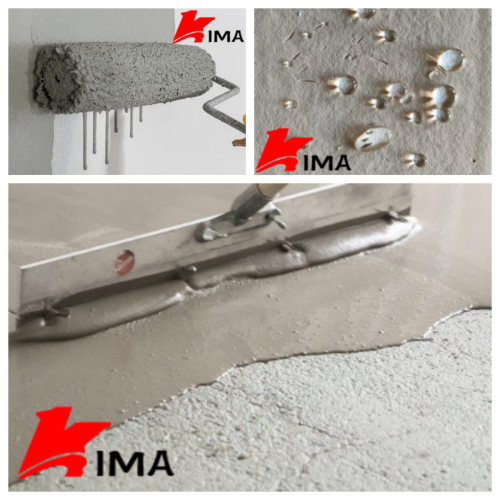
HPMC enhances adhesion by promoting uniform wetting and intimate contact between the coating and the substrate. Its water-retention capability prevents rapid moisture loss into porous concrete or masonry surfaces, allowing the cementitious binder to hydrate properly at the interface. This results in stronger mechanical interlocking and improved bonding strength. Additionally, the cohesive film formed by HPMC reduces shrinkage stresses during setting, further supporting durable adhesion.
Crack resistance is another one of critical hydroxypropyl methylcellulose benefits. During the curing process, cementitious coatings naturally undergo volume changes due to hydration and drying. Rapid water loss can intensify these stresses, causing microcracks that compromise waterproofing integrity. HPMC regulates moisture release and improves paste cohesion, which helps distribute internal stresses more evenly throughout the coating. This controlled curing behavior significantly reduces the risk of early-age cracking.
HPMC contributes to a denser and more flexible microstructure. By improving particle dispersion and reducing segregation, it helps create a continuous matrix with fewer defects. This enhanced microstructure allows the coating to better accommodate minor substrate movements, thermal expansion, and contraction without cracking. In combination with polymer modifiers, HPMC further supports flexibility and long-term durability.
By strengthening adhesion and minimizing crack formation, HPMC ensures cementitious waterproofing coatings maintain their protective function over extended service life. This results in reduced maintenance requirements, improved reliability, and lasting protection against water penetration in demanding construction environments.
Optimizing Rheology and Anti-Sag Performance in Vertical and Horizontal Applications
Rheology control is a key factor in the successful application of cementitious waterproofing coatings, especially on vertical and overhead surfaces. Hydroxypropyl methylcellulose (HPMC) is widely used to optimize rheological properties, ensuring balanced flow, stability, and anti-sag performance across both vertical and horizontal applications. Without proper rheology modification, coatings may slump, drip, or form uneven layers, compromising thickness control and waterproofing effectiveness.
HPMC acts as an efficient thickener and stabilizer, providing a shear-thinning behavior that is ideal for application. Under shear forces generated during brushing, rolling, or troweling, the coating flows smoothly and spreads easily. Once the shear force is removed, viscosity rapidly recovers, allowing the material to stay in place without sagging or running. This behavior is particularly important for vertical walls, facades, and detailing areas where consistent thickness must be maintained.
Anti-sag performance is further enhanced by the cohesive network formed by HPMC within the cementitious matrix. This network improves internal strength and prevents particle settlement, ensuring fillers and cement remain uniformly distributed. As a result, the applied coating maintains a stable profile, even at higher build thicknesses, reducing the need for multiple corrective passes.
In horizontal applications, optimized rheology contributes to smooth leveling and surface uniformity. HPMC helps control flow without excessive spreading, preventing material accumulation in low areas while still allowing adequate self-leveling. This balance ensures an even, defect-free waterproofing layer.
Stable rheology improves application efficiency and reduces material waste. Contractors can apply coatings with greater confidence, achieving consistent results across different surfaces and environmental conditions. By optimizing rheology and anti-sag performance, HPMC plays a critical role in delivering reliable, high-quality cementitious waterproofing coatings suitable for diverse construction applications.


 English
 日本語
日本語 français
 Deutsch
 Español
 العربية
 Türkçe
 italiano
 русский
 português
 Nederland