Redispersible polymer powder (RDP) is an important polymer modifier in modern dry-mix mortar systems, significantly improving the mortar's adhesion, flexibility, water resistance, and crack resistance. In the study of the mechanical and volumetric stability of mortar, drying shrinkage is a key indicator, directly affecting the material's crack resistance and durability.
The Nature and Influencing Factors of Drying Shrinkage
The drying shrinkage of mortar mainly stems from capillary pressure and microstructure rearrangement caused by water evaporation. When free water in the cement hydration products and fine aggregate system is lost, internal capillary tension causes volume shrinkage. If shrinkage is restricted, tensile stress will be generated on the surface, forming microcracks. Factors affecting drying shrinkage include:
Properties of cementitious materials (e.g., cement type and dosage);
Water-cement ratio and pore structure;
Aggregate gradation and volume fraction;
Types and dosages of admixtures, especially polymer modifiers such as RDP.
Mechanism of RDP in Mortar
RDP is typically composed of ethylene-vinyl acetate copolymer (EVA), ethylene-vinyl acetate-vinyl neopentyl glycol copolymer (VAE/VeoVa), etc. After dispersion in water, it forms a polymeric emulsion, which interacts with cement hydration products to form an organic-inorganic composite network structure.
Its main functions include:
Film-forming effect: RDP forms a flexible polymer film in the hydration system, improving mortar toughness;
Improved pore structure: Polymer particles fill capillary pores, reducing porosity and capillary water channels;
Interface strengthening: Enhances the interfacial bond between aggregates and cementitious materials, reducing stress concentration;
Stress relaxation effect: The elasticity of the polymer allows the mortar to partially release strain energy during drying shrinkage.
Effect of RDP on Drying Shrinkage
3.1. Trend of Shrinkage
Experimental results generally show that at low RDP dosages (<2%), drying shrinkage increases slightly or remains essentially unchanged; at medium to high RDP dosages (>3%), shrinkage increases slightly. The reasons are as follows: RDP contains a certain amount of organic components, which replace some cement hydration products, reducing the proportion of rigid phases; the polymer film has high hygroscopicity, resulting in rapid water loss during drying and thus additional shrinkage.
However, although the total shrinkage value may be slightly higher, the overall crack resistance is still significantly improved because the polymer film imparts higher flexibility and crack resistance to the system, effectively dispersing shrinkage stress.
3.2. Correlation between Pore Structure and Shrinkage
RDP improves the mortar microstructure: through particle filling and film formation, it reduces the number of macropores (>50nm) and increases the proportion of micropores (10-50nm), resulting in a more uniform capillary pressure distribution and avoiding localized stress concentration. This pore structure optimization, to some extent, inhibits the development of macroscopic shrinkage cracks.
3.3. Influence of Polymer Type
Different types of RDP have different effects on drying shrinkage:
EVA-type RDP has high flexibility and good film-forming properties, but slightly higher drying shrinkage;
VAE/VeoVa-type RDP is more hydrophobic, has low hygroscopicity, and lower drying shrinkage;
Acrylic RDPs, due to their high molecular chain polarity, have high water absorption and a more pronounced tendency for drying shrinkage.
Therefore, in engineering design, the appropriate polymer type should be selected based on the ambient humidity and intended use.
Synergistic Effect of RDP with Other Admixtures
In mortar formulations, RDP is often used synergistically with cellulose ethers (HPMC/HEMC) and redispersible powder toughening agents.
Cellulose ethers improve water retention and slow down water loss, thereby reducing the rate of drying shrinkage;
RDP improves flexibility and stress dispersion;
The combination of the two can significantly improve the overall crack resistance of mortar, especially suitable for external wall insulation systems and self-leveling mortars.
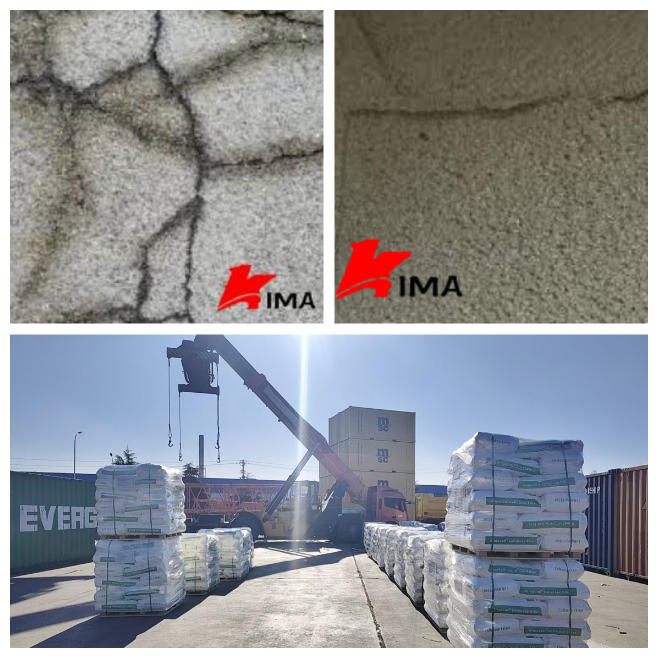
Application Practice and Control Strategies
In practical engineering, controlling the impact of RDP on drying shrinkage can be approached from the following aspects:
Reasonable Dosage Control:It is generally recommended that the RDP dosage be 1.5% to 3% of the cement mass, within which performance is optimal.
Optimized Mix Proportion:Shrinkage can be further reduced by increasing the sand ratio, using low-absorbency aggregates, and adding micro-expansion agents.
Selection of Suitable Polymer Type:Hydrophobic VeoVa-modified RDP is recommended for humid and hot environments.
Construction and Curing Management:Maintain stable humidity and temperature in the early stages to prevent rapid surface drying and cracking.
The effect of RDP on mortar drying shrinkage has a "dual" nature: its organic components slightly increase the overall shrinkage rate of the mortar, but by improving the pore structure and enhancing toughness and stress dispersion capabilities, it significantly reduces the risk of drying shrinkage cracks. Under scientific proportioning and proper curing conditions, RDP-modified mortar can achieve comprehensive performance characterized by high flexibility, low cracking, and excellent durability.


 English
 日本語
日本語 français
 Deutsch
 Español
 العربية
 Türkçe
 italiano
 русский
 português
 Nederland